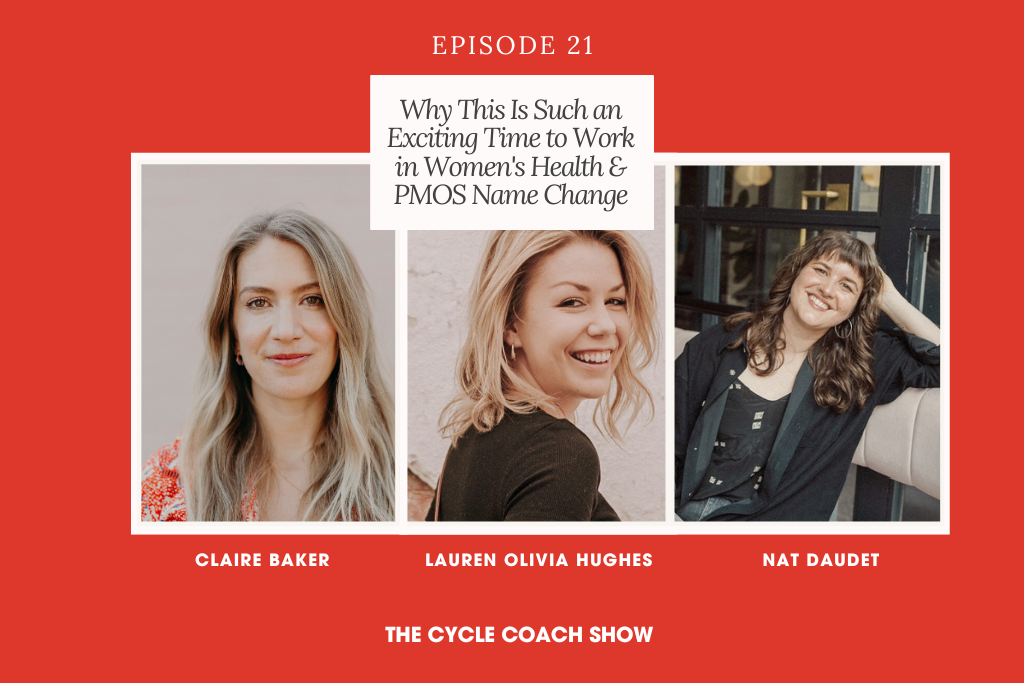
Episode 21: Why This Is Such an Exciting Time to Work in Women's Health & the PMOS Name Change
Listen on Apple Podcasts. Listen on Spotify.
In this solo episode, Claire reflects on why there has never been a more exciting time to be working in women’s health. From growing public awareness and increasing demand for cycle literacy to the evolution of research, language, and care models, she explores what it means to be part of a field that is still developing in real time.
A central focus of this episode is the recent change from PCOS (Polycystic Ovarian Syndrome) to PMOS (Polyendocrine Metabolic Ovarian Syndrome). Claire shares her own experience of being misdiagnosed with PCOS and explains why this shift in terminology matters so much. Far from being a simple rebrand, the name change reflects a deeper understanding of the hormonal and metabolic drivers behind the condition and has the potential to improve diagnosis, treatment, and support for millions of women.
Claire is also joined by Cycle Coach School mentor and fertility awareness educator Nat Daudet and for a thoughtful conversation about the PMOS name change. Together with Lauren, they unpack what this shift means for practitioners and clients alike, discussing everything from diagnosis and treatment options to the role of insulin resistance, hormonal health, and self-advocacy. Nat also shares her personal experience living with PMOS and why this change feels both hopeful and validating.
Throughout the episode, Claire reflects on the growing need for skilled practitioners who can do more than simply share information. She explores the importance of education, advocacy, relationship-building, and space-holding in supporting women through increasingly complex health conversations.
Click play to explore the PMOS name change, the future of women's health, and why there has never been a more exciting time to be doing this work.
Resources and Links:
Nat Daudet’s Website:Fertility Awareness Project
Nat Daudet’s Instagram:@fertilityawarenessproject
Fertility Knowledge Collective: www.fertilityknowledgecollective.com
Stay connected:
Cycle Coach School Website:www.cyclecoachtraining.com
Cycle Coach Instagram: @cyclecoachschool
Claire's Instagram: @_clairebaker_
Claire's Website:www.clairebaker.com
Lauren's Instagram:@laurenoliviahughes
Lauren's Website:www.findingjulian.com
Claire (00:45)
Hello friends, welcome back to the Cycle Coach Show. You are with Claire today, and I'm coming to you from the very end of my working day. And I've just had one of those days that leaves me feeling so inspired about the current state of affairs when it comes to women's health. Now, I'm not gonna lie, this does not happen every day. ⁓ many days I feel.
Frustrated and ⁓ really challenged by how things are. I always feel really inspired when I talk with my clients and with our trainees at Cycle Coach School about the things they're learning and what they're working on. But let's be honest, like there is ⁓ still a lot of stigma in this industry and in the wider world, there is a rule lack of funding and a lack of awareness. A lot of the time we can feel
really stuck and annoyed that things aren't further along when it comes to our health, how our menstrual cycles are perceived and related to, and so on. I don't need to tell you that, tell you about that. You get it. You know. You live and breathe this work as well. So I thought I'd jump on to record a podcast episode right now where I am feeling a bit jazzed up.
And I hope that it can serve as a bit of a pep talk and also to share some really exciting updates, not only from what is happening inside the school right now, of which we have some great stuff going on. Things feel really alive right now. But also, yeah, in the wider world, ⁓ we've got an exciting name change to discuss, a PCOS name change.
There's a great new documentary out on endometriosis in the UK, a New York Times article I want to chat about, and a few other things.
Before we get into that, you might be listening to this on one of the podcast apps. And if that was working for you, then awesome. But I just want to let you know that we're also uploading these episodes to YouTube now. So if you want to watch or you like using the YouTube app, then please come and engage with us over there. Really appreciate it. And whichever app you are listening on, whichever platform, your reviews.
really make a difference. It really helps these episodes to reach more people. And if you like what you're hearing, of course, we love your comments. We love your feedback. If you have questions, please share them with us. You can find us on Instagram at cyclecoach school and of course online at cyclecoachtraining.com. We're currently enrolling new students and we would love to hear from you if what we offer is something that you feel aligned with.
Or like me excited about. So let's get into it. Let's start with a topic that's quite close to my heart, which is the new endometriosis documentary. Now, I haven't watched this documentary yet. If I'm really honest, I will. But I'm taking a little break from engaging in endometriosis content.
Just because I recently finished Lena Dunham's new memoir, Famesick. You might know Lena Dunham as the writer and director behind girls. Now she has written exp in explicit detail in her new memoir about her issues with chronic illness, her journey with endometriosis. And I'll be honest, it is harrowing in parts. It's something that I feel like as someone with endo.
I crave, I crave these stories from other women and I'm so appreciative of them. It means so much that there are others out there who are willing to talk about the realities of living in a body that has a chronic illness. And at the same time, sometimes I need a little bit of a break. Now, if you yourself navigate any kind of health issue, you might hear me when I when I describe that.
Holding that tension between wanting to engage, wanting to be inspired, ⁓ wanting to learn and understand and connect on an issue, and then at the same time needing to just pull back a bit. So, with all of that said, I can't wait. I can't wait to watch this new endometriosis documentary. ⁓ it's been created by journalist Emma Barnett, and it is the UK's first documentary on endometriosis. It's called Fighting Endometriosis. It was commissioned
Through the BBC, and you can watch it on BBC, iPlayer. Now, why is this something to celebrate? Awareness really, really, really matters. Awareness helps more women hear and learn about chronic health conditions. And if we're speaking specifically about endometriosis, it can take.
Anywhere between seven to ten years on average for a diagnosis. It overlaps. The symptoms of endo overlap with so many other health conditions, ⁓ that it is often misdiagnosed. As things like IBS, ⁓ in my case, sciatica. yeah, there's just so many different things that it can be missed as, right? So awareness really matters.
The fact that money has been poured into a project like this really matters. That really, really matters. That says to us that there are resources out there that are available because enough people care about having these conversations and about really beginning to make a difference. So the fact that this documentary is out there and people are watching it and they're talking about it is something really to celebrate.
And there's something that my one of my mentors, Alexandra Pope, said to us when I took their training through Red School back in 2017, about nine years ago now. She said, as a nearly like a you know, parting wisdom was be mindful not to waste your chi on people who don't have the ears to listen. And by that she meant.
The way I understood it was, you know, be really mindful with your energy. There's a lot of passion here, there's a lot of excitement. There's, you know, so much you want to say and talk about and share. But just be really mindful that you're not wasting your chi, your energy, your life force on those who just simply don't get it. People who don't understand or yeah, your work's not really going to be for them. And I think that's really smart advice. And
It relates to this awareness piece because we do really want to make sure that we are speaking to the people who are gonna get it. And the people who have ears to listen are increasing day by day by day. ⁓ my God. Like I just I mean, the fact that this is U the UK's very first ever documentary on endometriosis says a lot. You know, this would not have been funded five years ago, ten years ago. ⁓
That's just really it's just really, really exciting that there are more and more people with ears to listen. And it relates as well to this New York Times article that just popped into my inbox a couple of days ago. Now, this piece is on a TikTok trend of all things that is about women in perimenopause reaching for antihistamines to alleviate their symptoms. Now, I'm not going to comment on whether or not that is effective or not effective, safe or unsafe. ⁓
But what I do there's a couple of things here that's really interesting. So
What this says to me is that women who are in perimenopause are looking for answers. They are seeking, they are searching, they are looking for answers. They want to understand what is happening in their bodies, right? And and fair enough. There are, again, like endometriosis, there's not a lot of understanding when it comes to perimenopause.
And because the experience is often so different from woman to woman, it can be really difficult to say, this is what perimenopause is, this is what the symptoms are, and this is how you can manage it and feel good and feel good, right? Everybody just wants to feel good. And so this trend around using antihistamines to ⁓ to treat some of the symptoms that come up for the for women in perimenopause is is fascinating, that it has become a a viral TikTok trend.
Again, I'm not commenting on whether or not I think that this is effective or not effective. In general, I don't think that we should be seeking our health, our unique health advice on social media. We need to be working with qualified practitioners who can actually work with our unique situation. But I I honestly don't believe that there are enough practitioners out there who are educated on the menstrual cycle and who have.
cyclic understandings and who can really sit with a woman who is in perimenopause and he and listen to what she has to say and to really hear her story. I mean this is why I do what I do. This is why I founded Cycle Coach School. I started this training so that more practitioners who work with women in the female mind and body have these understandings. Now I don't there's plenty that I don't know. There's plenty that we don't know in general about women's health.
But I do know how to be a good practitioner and I do know how to sit and listen and I do know how to ask great questions and I do know how to really be with someone in their experience. And so often when we have that kind of space held for us, a lot of the time we actually end up finding ⁓ the answers on our own or the wisdom, you know, within ourselves. ⁓ not always, but sometimes that can happen through coaching. So
The fact that this is a viral TikTok trend tells me that there are women out there who are desperate to have that kind of space held for them, to have somebody listen, somebody who understands, somebody who can share genuinely ⁓ helpful recommendations on how to nourish their menstrual ecosystem, how to take care of their body as it navigates the the chapter of life that is perimenopause. Desperate. Desperate. They've got the ears to listen, right?
And the fact that the New York Times that a publication of that status and that size picked up this story and thought, yeah, we're gonna publish it this, we're going to run with it, we're going to speak with experts about this. Like, I think that's awesome. I really, really do. I think that's really exciting and encouraging. I don't tend to get, like I said, caught up in the tone of these things. I I I just I really do think that.
These this is these are all really good signs. These are all things that we can feel really encouraged about, honestly. Again, I'm not commenting on whether or not we should feel encouraged by women ⁓ self-prescribing antihistamines. What I'm saying is we need to be encouraged by the fact that that more and more women have the ears to listen and they're so they're searching and they're seeking and they're looking for people like you who have great knowledge to share and great practitioner skills, you know, to be able to support them.
So there's more demand than ever, truly. And the final piece that I want to share from the outside world today is this name change that is just really incredible and astonishing, I think. So long story short, for the last 14 years, ⁓ there has been a team of people who I must say are Australian out of Monash University here in Australia who have been campaigning this ⁓ initiative to change the name.
Of polycystic ovarian syndrome. Now, what does a name, why does it matter? Like what's in a name? Why does a name change matter? Of course, language really matters, right? And what makes a syndrome different, say, to a disease, is that a syndrome is a collection of symptoms. So the way a syndrome is diagnosed is through a like a almost like a checklist of symptoms. Now, in
literally in the name of polycystic ovarian syndrome is the word cystic, cysts. And so for a really long time, the cysts were one of the top criteria required for diagnosis. Now, not every woman who has polycystic ovarian syndrome, as it was called, actually presents with cysts on their ovaries at all.
What we know about this syndrome is actually that it's far more about our hormonal landscape and hormonal imbalances. It's about insulin resistance. It's about metabolism. It's not necessarily a gynecological issue at all. It's connected to our reproductive system. It's connected to ovulation and to ovaries. ⁓ But that's not the driving force. And so
What was happening is that a lot of women were being misdiagnosed with PCOS because they had some cysts on their ovaries. And a lot of women were not being diagnosed who do have this syndrome because they simply didn't tick that checkbox of of cysts. Now I myself was misdiagnosed with PCOS about 14, 13, 14 years ago.
Because I had some cysts presenting on my ovaries. Now, knowing what I know now, it's very possible that they may have been endometriomas, knowing that I have endometriosis now. hard to say. But also because my I had ⁓ aminerrhea, which is no bleeding, so I had gone for a full year without a period. This, I believe, was due to having recently come off hormonal birth control and also.
living through one of the most stressful periods of my life. my brother had a motorcycle accident, which left him with a traumatic brain injury, and it was just an in really full-on and intense time for my family. And so I was diagnosed with PCOS and I just I didn't meet any of the other any of the other criteria.
And even at the time I remember thinking, I'm not sure that I have this. I don't have any of the other symptoms ⁓ that are required or that are listed as a part of this syndrome. And then years later, I had a doctor ⁓ confirm my suspicions that no, I I don't actually meet the criteria for PCOS.
So I'm not alone in that experience. There's so many women who have been misdiagnosed with this or not or have been missed and diagnosed possibly with something else because of this ⁓ this criteria around the cysts. So this team at Monash University pushed to have this name changed. And it's taken 14 years of research, of surveying, of doing various workshops, talking with people who have what is
now known as polyendocrine metabolic ovarian syndrome, so PMOS, and and campaigning and ⁓ and having money and and and funds poured poured into this. And it's going to really make a huge difference for women all over the world. Truly, this can really change the trajectory of how we understand, diagnose, treat, and work with.
What is now known as PMOS. You know, the fact that our understanding evolves is so exciting. The fact that our language evolves is really exciting. The fact that attention and resources are being directed, here is evidence of it, towards women's health is really exciting. Women's health, our health, our bodies, you know, it's they're not static. There's so much we still don't understand. And and that's okay because it means
That there is a great deal of potential. I had a mentor say this to me years ago, you know, with whenever there is anything unknown, there is so much potential. And I know it can feel easy and understandable to feel frustrated by how little we know when it comes to the female body, but damn, we've got to take those those glimmers of hope when they arise, right? Like this work is alive. And and I I'm genuinely really comforted and energized by this. So let's have a listen to Lauren.
And Nat Daudet from Fertility Awareness Project talking some more about this exciting name change.
Lauren (18:08)
How is this feeling for you as someone who has PMOS now?
Nat (18:14)
It's so exciting. I feel very hopeful and very excited and like, it's very affirming personally, because like, my I wrestle so much with trying to understand PMOS and so that I can help other people understand it too, because it feels so confusing and like,
so connected to diet culture and so connected to food rules and just a lot of shit. my hope is that people will feel more competent to advocate for themselves and give us more language to share resources so that people can advocate for themselves and feel hope.
that things can change in their own health. And like, it's also just hopeful for like, that enough attention was given to like a disorder that affects women and it's like, maybe things are like changing, like maybe they're, or just paying more attention and like putting more resources into it. So I feel very hopeful and excited and like giddy kind of.
Lauren (19:30)
Can you describe what has happened in the last week?
Nat (19:33)
Mm-hmm. Yeah, so basically my understanding is like there was a big push to to consult with doctors and patients I believe to change the name and choose a new name like there was like a process to change the name intentionally from polycystic ovarian syndrome the cyst
Part of PCOS is so sticky because like when I had like I had a vaginal ultrasound to like diagnose PCOS and part of the diagnosis is cysts on your ovaries. And you can have cysts on the ovaries and not have PCOS like just depending on where you are in your cycle. You can have these like follicles.
And you can also have PCOS without having the cysts. So there's this huge focus on cysts and it's not a helpful way to diagnose it. So there was like surveys done and conversations and panels to pick a new name. So.
Lauren (20:35)
Mm-hmm.
Nat (20:42)
Moving from PCOS, or polycystic ovarian syndrome, to PMOS is basically saying like, polyendocrine is referring to like a hormonally driven syndrome. So we talk about like things like insulin or androgens or LH driving the symptoms that show up in the cycle. Like there was so much focus on it being
of the cycle, is part of it. Like that's how a lot of people find out they have PCOS, but it's actually like caused by something else before that, like before it gets to the cycle and ovaries, which is like our elevated androgens or being insulin resistant. And then the other piece of that is the metabolic piece. So it's like your body's way of processing energy, processing blood sugar,
Lauren (21:27)
Mm.
Nat (21:37)
processing like insulin and having cells that are more resistant to insulin is super common with PMOS. So acknowledging that piece of it. And then the ovarian is still like still in there because like it does relate to our like ovarian hormones. It relates to ovulation, irregular cycles.
I think it like takes also like a lot of blame away from people like thinking that they've caused their their symptoms and recognizing that it is just like
hormonally
driven.
Lauren (22:16)
So it feels like we've shifted away from the cysts being kind of like the umbrella, like we need to find cysts and that'll explain what you have because you're saying you can have cysts and don't have PMOS and vice versa. So now we're shifting away to like focus on hormones and your metabolism and like your cycle is just a symptom. So it's left about looking at
uterus and being like, that's the problem and it's affecting the body. It's the body's effecting the cycle. Is that right?
Nat (22:49)
Absolutely and like the
crazy thing about it and I think why it's so Powerful is like because we know so many people prescribe birth control when they are they when they go to their doctor And they're like a happy irregular cycle. So if you think of it as just a cycle issue Then yeah, you're going to think birth control is an appropriate treatment. But once you change the medical name Then actually we need to treat the hormonal
Lauren (23:00)
Hmm.
Nat (23:16)
cause of this and yes like lifestyle things can be helpful like for me I will go on and on and on about strength training but it's because our muscles are like a glucose processing organ and so if you're someone who's insulin resistant if you have like a lot of circulating insulin it can be so helpful to like focus on things like strength training or like
Lauren (23:29)
Hmm.
Mm-hmm.
Nat (23:39)
blood sugar is an issue then like it is really important to focus on like eating fat protein carbs and fiber together if you are someone PCOS and like It's like taking the it's like taking the blame away from being like you cause this or like this is because of the way you eat or just because of the way you move I mean actually your system is like predisposed to needing extra support and like by
by doing these things, at least this is how I see for myself, by doing these things, I can take care of myself in the long term and be proactive about my health. Instead of just being like, here's birth control, that's not going to help the insulin resistance, that's not going to help the androgens. So it's a really powerful shift for people to also go to their doctors and ask for these, if we're saying it's polyendocrine, that means you can.
Lauren (24:18)
Bye.
Hmm.
Mm-hmm.
Nat (24:38)
advocate for having your hormones checked before your prescribed birth control. So I think the fact that it's so ingrained, or it's going to be ingrained in the medical system means that I'm hopeful people will want to dig into more of the why behind why somebody has it.
Lauren (24:42)
Okay.
Mm-hmm. Well, and it's just interesting to like shift it away from, it's just a fertility issue or like hop on birth control. then I love I mean, I was on birth control for 10 years. It served its purpose. Like, and I know it helps a lot of women in different seasons of life, but it is sometimes prescribed as like almost like an Advil for the uterus where it's just going to like blanket whatever problem you have. just like that. So like with PCOS,
Nat (25:05)
Totally.
100%.
Lauren (25:27)
Does it, is it just hiding the symptoms? So it feels like it's working, but it's just, and then you go off of it and you're back to square one.
Nat (25:35)
the classic sign of PCOS is irregular cycles. So we're having this delayed ovulation. You'll have cycles that just are not regular. And then when you go on birth control, you will have these, you will have withdrawal bleeds or you have pill bleeds, but you're not actually like restoring ovulation because obviously if you're on birth control, most types of birth control are not going to, well some will, but not.
all of them will let you ovulate every cycle. So it is masking the problem, which again is fine. That is the only option for a lot of people and it isn't the end of the world. It's more so like we wanna have the option to take care of our metabolic health and being on birth control just doesn't allow you to be like, okay.
are the things that I'm doing working to restore population, if that's important to you.
Lauren (26:28)
Mm-hmm.
Nat (26:31)
I think it's just like not allowing you to like see your, your, your true cycle. And it is a band-aid fix not to like moralize band-aid fixes because birth control is like the only option for a lot of people. But the fact that that's the solution is just like frustrating. Yeah.
Lauren (26:40)
Mmm.
Yeah. So then
you mentioned like a variety of different hormones. So is it kind of like per person can depend on how it shows up in their cycle.
Nat (26:59)
Yeah, so for me, and I think this is pretty common, I think like it's like 85 % of people experience insulin resistance for whatever reason, they don't really know why, but it can be genetic or environmental. And then what happens is insulin affects your ovarian hormone production. So if your cells are resistant to insulin,
Lauren (27:27)
Mm-hmm.
Nat (27:27)
then
you will have higher, like more insulin will be created And then if you have high insulin because your cells aren't like opening the door to insulin, that key isn't working anymore. Then what happens is your body increases its androgens and androgens are hormones that disrupt ovulation. So,
Lauren (27:38)
Mm-hmm.
Nat (27:49)
you'll see the antigens being thrown around and that's linked to insulin. But then you'll also see like people with PCOS sometimes have elevated LH. So luteinizing hormones starting in the brain is like that nice feedback loop that like connects between the brain and the ovaries. And if that feedback loop is not working, then you'll have these long cycles where you're trying to ovulate multiple times or like you're taking LH tests and they're always positive, but you're not ovulating.
LH is out of balance, essentially. So insulin isn't just a blood sugar hormone. It affects ovarian function, which is something that for me was like, just took me so long to like fully wrap my head around. And then that high insulin then impacts your androgen production.
Lauren (28:35)
Yeah.
Nat (28:41)
and that interferes with regular ovulation. How it does that, I'm still unclear about. Like how androgens and estrogen, like I'm pretty sure, I'm fairly sure that estrogen would be high as well. And then that's impacting like that brain ovary feedback loop, but I'm not 100 % sure.
Lauren (29:01)
it's interesting. Like literally last week I was, did like a reel about, you know, don't always like go into your doctor and expect them to know the answers because it's like, we're still figuring it out. like you said, it just feels like they're paying attention to women's health in a different capacity and giving it the attention and hopefully funding it deserves because we're more than 50 % of the population
So it feels like really nice step forward. And, and yeah, just beautiful, beautiful timing on all of it. I've just, yeah, new season, new, new terminology. Great.
Nat (29:33)
New terminology. It's possible. This is one day change. It's wild.
It's funny how when you change the name of something it is strange because the other piece of it is like the identity that comes with like labels or diagnoses it's like that becomes like so...
empowering and then it's like we're going to change the name and like changing your whole kind of orientation to the thing as well.
Lauren (30:00)
Thank you so much for this little debrief on the rebranding of PCOS to PMOS.
Claire (30:08)
All right, you're back with me. I'm so curious to hear your thoughts about this change. Please come and share your reflections in the comments, send send us an email, reach out and let us know. Let's keep this conversation happening. I think what stands out to me listening to Nat and Lauren discuss this is that it's not yeah, it's really not just about the name change. It is this reminder that this field is alive, it's still developing, there are still enormous gaps.
There are a lot of women looking for answers. I really liked what Nat said at the end there about the identity shift that can happen when something is renamed. What does it mean to really identify with the diagnosis that we receive? And how does that shape our understanding of how we how we work with the diagnosis? Like Nat said.
when we change the name and we change the understanding, the whole approach of how we actually work with this can shift. And that's really exciting, especially for menstrual cycle coaches, because especially with This PCOS to PMOS change, it reminds us that there are so many lifestyle changes that we can make that can support our bodies. Not necessarily cure, not necessarily put into remission or, you know, completely ⁓
Transform necessarily, but we can change how we feel and how we live and how we show up. It can make a really big difference. Like Nat said, Things like strength training, eating balanced meals, the basics, getting enough sleep. Like I find it really encouraging because this is what we teach at Cycle Coach School: The importance of nourishing the menstrual ecosystem through these pillars that kind of sound basic and a bit boring.
But they're the ones that move the needle. you know? They really, really do. And so, as practitioners, there's so much that we can offer people when we know what we're actually working with. And I think that this change ⁓ helps practitioners because it it also helps our clients make sense of their experience. And, you know, coming back to what I said earlier, I believe that our awareness here and the need and the demand.
For more information and for more skilled spaceholding is higher than the number of skilled practitioners who are available to meet that need. I really do believe that our awareness is growing faster than practitioners. Women need skilled guides. They need people who are able to actually meet them where they are. And there is a huge, huge opportunity right now.
⁓ to like I said, to meet those women who have the ears to hear. So what do women actually need? What do women actually need right now?
Information is good. Information is helpful. Education is helpful. But I don't necessarily think that.
information on its own is enough. I don't necessarily think that they need a whole lot more reels. I don't necessarily think that they need lots of hormone hacks. I think women are looking for practitioners who can listen, practitioners who can sit and hear their story, practitioners who can educate but who know how to move between educator and coach, teacher and facilitator.
Like people who are dynamic in their space holding, who aren't just going to to you know, to do one thing. I think we're looking for people who are able to really, you know, be dynamic with us in our in our needs. Sometimes we need someone to listen. Sometimes we need someone to offer recommendations. Sometimes we need someone to share resources. And this is what a psycho coach can offer is this dynamic space holding that is so different to what is
Is currently on offer in so many other fields of health, right? People who can hold complexity, practitioners who can facilitate great conversations, empathetic facilitators, people who can help women to reconnect with their bodies and who understand menstrual cycle awareness deeply, who get that the female body is cyclical. And so that that understanding impacts.
how we hold space for other people. You know, one thing that we talk a lot about inside Cycle Coach School is that knowledge alone isn't enough. So it's great that we have all of this new awareness. I'm celebrating it and championing it so hard.
But then what? Like where do these women go who watch this this this incredible documentary or who read these New York Times articles or who are doing this anti-histamine TikTok trend?
Where do they go? You know? Like, where do they go?
This is why I really believe in what we're doing here at at Cycle Coach
I had a great conversation today with one of our trainees who works in disability. And she works with women who have disabilities and need a lot of care and support around menstruation and around their menstrual cycle. And it just struck me like how many industries could benefit, especially in care and support.
Service providers who are working with women in the female body who could really benefit from knowing more about menstruation and about the menstrual cycle, not only to share with their clients, but also for themselves. Like if there is somebody who is, you know, a disability support worker who is working really ⁓ directly with a client who has ⁓ high needs and
You're working directly with someone who is menstruating and helping them to take care of that experience. And if you walk in that door and you have your own shame and your own stigma and your own stuff and hang-ups around the menstrual cycle, it's going to be really difficult to not transfer that onto your client. And I see this a lot in in practitioners, not just in disability, but you know, across the board. If if we as practitioners haven't worked with our own stuff and
Sat with the experience of being in a female body. This is why it was so important for me that this training felt also not only like a professional undertaking, but a personal journey. It's really important that we continue to be with our own experience of being in a cyclical changing female body. So.
I believe that's really what women are looking for right now is practitioners also who have done that work and who are doing that work and walking alongside them, not necessarily as someone who has all the answers, but as a guide, someone who gets it and is going to be able to sit with them, not only in the joys, but also in the challenges of being in a female body.
Claire (37:27)
So, what actually makes a great practitioner? So, a great practitioner isn't necessarily going to be the person with the most amount of followers on Instagram. I know it's a wild concept, but it's true. The most amount of followers, having a really shiny brand, these things can be really helpful in terms of our marketing and reaching more people, but they don't necessarily indicate
That this person is a skilled and trained and qualified practitioner, someone who's actually able to hold space well and listen and meet clients with nuance and context. Now there are a few qualities that I see in great practitioners. you might be familiar with these, you might know these qualities within yourself, you might have noticed them in people that you've worked with. I think number one is really that they know how to listen. They know how to.
be with you, sat with you, maybe in a session or in a workshop context, and they're going to really be present and listen to what you have to say. They're going to ask great questions. Questions that inspire you to reflect on your own journey, that draw out your own wisdom, questions that are open-ended, questions that are about you and and help you to to share and and talk things through and
So often, you know, in coaching.
The client comes to conclusions themselves that, like, I could never have come to for them. They're the ones that know their life far better than I do. They're the ones that know the context of all of the different tips and tricks that they've tried over the years. They know about the realities and the parameters of their life far better than I do. And so if I can ask a really great question, then that is what inspires somebody. That's what gives them an opportunity to.
Pause and reflect and often come to an insight that can really be life-changing and transformative for them. Far better that they come to it than you know than I do, honestly, especially when it comes to motivation and moving forward. So listening, asking great questions, affirming a great practitioner is supportive and encouraging. They are great at seeing the strengths in their clients and at
Are celebrating their wins, recognizing the effort that their client has been making. Because ⁓ my gosh, this work, you know, it takes work to really begin to come into connection with our bodies and track our cycles and live in greater congruence with the ups and downs and the rhythms of our hormones and tune in to our cyclic creative energy and bring this work into our relationships and so on, you know, like wow.
There is so much to celebrate. Whenever I meet with my clients, I'm always just blown away by the effort that they have been like showing and putting in, the difficult conversations they've been having, the time that they've allocated for themselves in their calendar, experiments that they've been making, right? Like a great practitioner is really good at acknowledging that. And this, you know, we haven't even got to information, you know, sharing information and education yet. This is all about.
Holding great space. So they understand as well that women are complex. ⁓ It's very rarely black and white. We need to know how to meet our clients in the complexity of their lives. And there is not always going to be a really simple answer to a question. They know that they're not there to fix things. ⁓ They are able to hold, hold that nuance, hold the tension with their clients.
Great practitioners are willing to keep learning. They're willing to say, I don't know, or I'm going to find out, or there's a topic that I'm interested in. I'm going to take some time and invest my energy and finances and precious hours into learning more about that. And sometimes that's structured learning, like a training.
Sometimes it's checking in with a peer and asking for a great resource, reading a book, maybe listening to a podcast, but they're willing to continue to update their skills, their qualifications, their understandings. Like we've been saying through this whole episode, women's health is evolving. It's changing all the time. So we need to be open and willing and hopefully excited to keep up with that.
Right. To keep evolving and and and let our our work and our body of work be alive as well. ⁓ What else? What else makes a great practitioner? I think that, you know, perhaps most important is they are able to build trust. They are able to build trust with their clients.
And this comes through everything that we've spoken about so far. It comes through being a great listener, asking great questions, being genuinely curious, being present, being willing to not have all the answers, being willing to be in the gray space, ⁓ you know, being willing ultimately to be a a human ⁓ and to really be be with our clients and to ask for consent before giving advice to
Recognize the parameters of the modality that they work within and stay within those boundaries to not promise things that they can't fulfill on, to not make guarantees that are not actually a real likelihood, right? So practitioners who are honest about the limitations of what they can offer is so, so important. And this is something that
It's a bit of a wild, wild west out there, honestly, in in wellness. And we all know when what I'm talking about when I say that there are people out there making promises that they cannot deliver on. And so building trust is so, so important. Women are often arriving to work with a practitioner with experiences of not having, you know, of having that trust broken.
⁓ whether that's because somebody hasn't listened to them, because they've been misdiagnosed, because ⁓ they've had their pain denied, or you know, simply no one's just taken the time to be curious and present with them and and lean in, right? They maybe they've had experiences of not being believed, feeling confused, trying so many things and nothing works, or it works for a little while and then it doesn't work again, or
Getting conflicting information, fragmented pieces of knowledge from like TikTok or YouTube or their doctor or a friend, like, you know, it's a lot. It's a lot, right? And so when some you know, by the time you meet with with with a client, something that I like to remember.
And remind all of our students who come through cycle coach school is that, you know, by the time you're sat across from somebody, it's it's likely they've already tried a lot of things, especially somebody who perhaps is dealing with a chronic illness like ⁓ endometriosis or a syndrome like PMOS. Remember that they've really been on a journey. So if you can sit with that person, sit with that human, that woman, and listen to what she has to say really carefully, help her make sense of her experience, validate
The the things that she's tried, celebrate her wins, be with her in the tension of the gray area and the not knowing. Like that is so incredibly powerful. And honestly, it's what keeps me so engaged and inspired ⁓ in this industry, truly. We're doing a lot of live practice coaching calls at Cycle Coach School at the moment. We're about to open up quarterly office hours, which I'm really excited about.
I'm doing one-to-one supervisions with our self-study trainees right now too. So I feel like I'm really in ⁓ yeah, in the work in a really exciting way. And and this is, you know, everything we've discussed today, it just keeps coming up. Like, how can we continue to stay energized by this industry and inspired and uplifted, despite the fact that there are frustrations and challenges? Like, what why are we here? What motivates us to keep showing up for our clients?
⁓ how can we stay alive alive to the evolution of women's health?
And as we do that, we become better practitioners. And like I said, The need for skilled practitioners is not going away. It is only, I think, increasing because women have ears to listen more and more and more. And they don't just need information. They really need guides. They need people who can educate as well as listen and hold space. They need
facilitators, they need people who can help them to navigate all of this information in a way that is unique to their experience, in a way that feels grounded, realistic, inspiring, and human, right? And yeah, it's one of the reasons why we're bringing in more connection with our alumni and our and our current trainees at the moment. We've done some practice coaching calls this week where we've had
Current trainees and alumni attend. And that's been so awesome to have that, you know, have these, this bridge between folks who trained with us years ago and are out there doing the work, coming back in and refining some of their skills with people who are who are coming in now. These opportunities for discussion and learning from each other. It ⁓ yeah, it just lights me up so, so, so much. So much of practitioner development.
Happens in relationship, whether that's with our clients, whether that's with our peers, with our supervisor. It happens when we start practicing, when we're when we're actually speaking and we're in conversation, ⁓ when we're showing up for our audience. It happens when we are asking questions, when we're campaigning for change, when we're out there supporting women by raising awareness for these issues that really need awareness. And
You know, it's really about finding you know, finding our voice in this work, which is something that we can talk more about on another podcast episode. I know we're we're nearing the end ⁓ today.
Before we finish, there's a couple of people that I really want to celebrate. And the first one is ⁓ Lauren, who is back from maternity leave. You would have heard her on our most recent episode and of course this episode today. So welcome back, Lauren. It's a delight to be ⁓ co-hosting this podcast with you across hemispheres. So I'm so pleased that you are back creating. And Lauren has some awesome interviews coming up. So really celebrating the season that she is in and the fact that she's still able to come and share on this podcast.
Makes me so happy. And I also really want to share one of our alumni, Franzi Ranal, who just ⁓ published her first book. It's in German, it's the first book in the German-speaking language on menstrual cycle awareness. It's called Ziclus Power, Z-Y-K-L-U-S Power, and it just looks like it has gone gangbusters in Berlin. Franzi's been doing book tours and events.
sharing this book. And so if you are one of our many German-speaking listeners, we've had a number of trainees come through the school who are are German or who speak German, then definitely check out Franzi's book and you can find her on Instagram at Zikless Power and we'll put the link for that as well in the show notes. I'm gonna leave you now and
Yeah, I'd love to hear from you. What lights you up? What keeps you coming back to this work? What helps you to feel inspired, you know, despite the challenges in women's health? I really believe that we need more thoughtful practitioners, people who are wisdom carriers, people who can actually meet clients, not just with information, but also with space holding skills. And it's not about doing it perfectly, it's not about doing it.
you know, even with like total certainty, it's okay to not have all of the answers. We don't have to pretend that we do. I certainly don't, because really what women need right now is guides, you know, educators, advocates, facilitators, people who can hold nuance with them, people who are willing to keep learning and people who really care.
And I know that there's so many people in our community who fit that bill. So if you have been feeling drawn to this work for a while now, if you know that you have a unique perspective on this, if you have a story that needs to be told, a passion that is burning because you have felt the impact of menstrual cycle awareness on your life, I would love to invite you to come and join us at Cycle Coach School because this field is growing.
And the need is there. So you can find us at cyclecoachtraining.com. We're enrolling now for our next certification round later this year. Please reach out if you have any questions at all and keep going, keep sharing, keep the momentum, keep the faith. And the more that we can have these conversations together, like the the brighter the fire burns. All right, I'll see you soon.
Thanks for listening.

Thank you so much for listening!
We love that you've taken time out to listen and explore more about menstrual cycle coaching . If you loved this episode please share it with someone you know will benefit, and/or on social media.
You can also leave a review on Apple Podcasts, this will ensure more and more people will have access to this content and one-by-one we can change the way the world views cycle coaching!
Subscribe to The Cycle Coach School Show so you never miss an episode: