

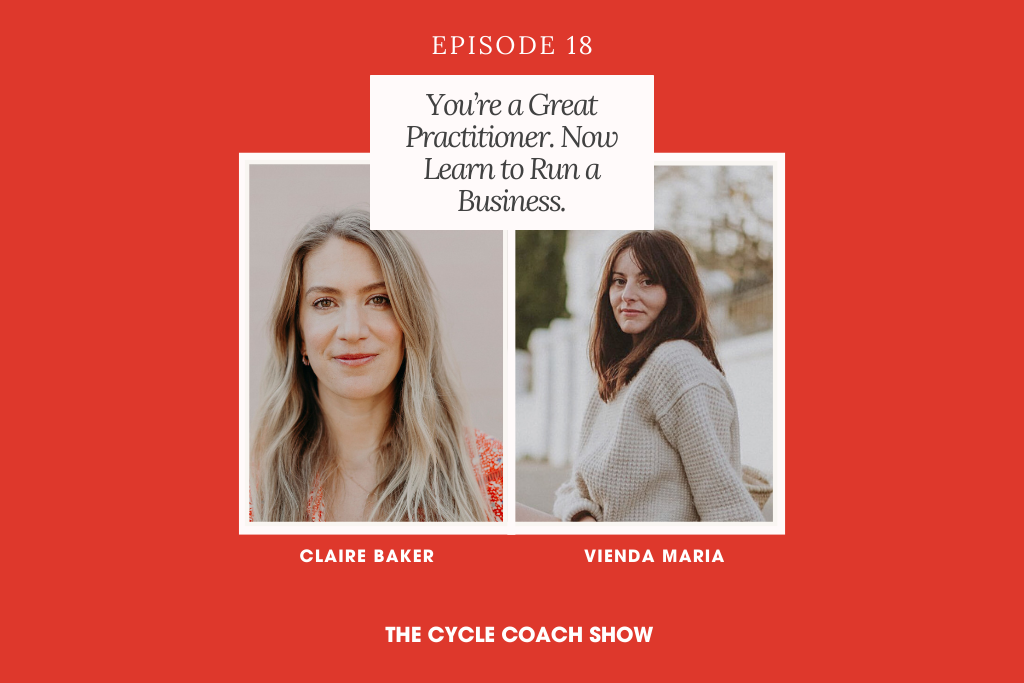
Episode 18: You’re a Great Practitioner. Now Learn to Run a Business.
Listen on Apple Podcasts. Listen on Spotify.
We’re back for Season 3 of the Cycle Coach Show, and Claire opens this new chapter in conversation with long-time friend, collaborator, and fellow business owner Vienda Maria.
Claire and Vienda have known each other for over thirteen years. They met in 2013 while enrolling in the same online business training, both at the beginning of their self-employment journeys. Since then, they’ve built sustainable, evolving businesses rooted in meaningful work — mentoring, writing, practitioner training, and cyclical living — while navigating the realities that come with running online businesses across continents and life stages.
This episode is an honest and grounded conversation about women in business. Not the glossy version, but the lived one.
Together, they explore what it really takes to build a business that supports your freedom, your creativity, and your nervous system. They speak about the tension between flow and structure, the vulnerability of being seen, the emotional edges that surface when your work is personal, and the deep personal growth that entrepreneurship inevitably brings.
If you are a practitioner, coach, facilitator, writer, or creative who feels confident in your craft but uncertain about the business side of things, this episode will meet you gently and honestly. It’s a reminder that building a business is not about becoming someone you’re not — it’s about developing the skills that allow your work to reach the people it’s meant for.
Claire and Vienda share about the business training where they first met, and the program they continue to return to over the years. You can learn more about that here:
https://viendamaria.com/bschool
Whether or not this particular training is right for you, this episode leaves you with one simple question to carry into your week:
What does your business need from you today?
Resources and Links:
Connect with Vienda:
https://www.instagram.com/viendamaria/
https://thementortraining.com/
Stay connected:
Cycle Coach School Website: www.cyclecoachtraining.com
Cycle Coach Instagram: @cyclecoachschool
Claire's Instagram: @_clairebaker_
Claire's Website: www.clairebaker.com
Lauren's Instagram: @laurenoliviahughes
Lauren's Website: www.findingjulian.com
Vienda (00:01)
I think it's really important to understand that starting a business is like a personal development program. It's going to bring up all of your stuff, all of your insecurities and tender places and all the things we have around being seen and being enough and rejection and failure. And what happens with being a container like B-School is it gives you this steadfast cheer.
So you can have all of this emotional stuff going on, but you have something that you can come back to and show up to over and over again.
Claire (00:34)
Welcome to the Cycle Coach Show Empowering conversations on menstrual cycle coaching. We're your hosts Claire Baker and Lauren Olivia Hughes.
Claire (01:03)
Well, I think this is a great place for us to start our conversation because dear listeners, welcome back firstly to the Cycle Coach show. We've had our annual winter break and we're back with more episodes. And today we're speaking with a really dear friend and business peer, Vienda Maria. And we have just, we have first of all known each other for over 13 years now. We've both been in business for a long time, you know, between us, like over 25 years of online business. And we have just spent 17 minutes trying to figure out the audio for this conversation. I'll tell you what, every year I think the internet will improve and there's, you know, you just always faced with difficulties here and there.
Vienda (01:54)
It's hilarious because you would think that the most basic thing like turn the microphone on, open the camera is like a nature by now, but for some reason technology is like I don't feel like working today. Sorry. Bye
Claire (02:10)
We both run internet-based business, which is really a lot of what we're going to speak about today in this conversation. We feel, I think, both of us really passionately about business, about women being in business, and about the liberation of that self-employment allows both of us.
What having our own businesses has meant for our lives and for our craft and for the meaningful work that we both do in the world. So we're going to speak about that today, but I do think that it is helpful to be honest and say there are of course complications. Like it's not as easy perhaps as some influences might portray that, you know, we sit there by the pool with our laptops, just happily typing away. I mean, right now you're in India, I'm in Sydney, in Australia, and there are complications. There are things to navigate when it comes to having your own business, right? Yeah.
Vienda (03:14)
There's plenty of challenges. And I think one of them is to also recognize running a business is a choice that you make for a particular reason. And it can't be something that, you know, the grass is greener. It has to be a decision you make because you know that's only in the right way for you personally. And I think we're going to dive into that a little bit today to understand whether that's right for you or not.
Claire (03:41)
So how did we meet? I think that's a great place for us to start because it really anchors us into what we're talking about today, which is about ⁓ an offering called B-School, which is where we met that we're going to speak a little bit more about later today. So it was 2013. Why did you sign up for Marie Forleo's B-School training?
Vienda (04:05)
Because knew I had skills that I wanted to offer the world, but I didn't know how to. I didn't know how to present them to the market myself, to offer them, to show up. The craft and the work that I wanted to do felt so distant and so scary to me. I knew I needed something that offered me strength, systems, and processes that I could easily follow. And that's what attracted me to B-School.
Claire (04:30)
Because you're an extremely sensitive and intuitive creative being. And this is what I love about you and it's what makes your work so meaningful as a writer, as a coach, as a mentor, as a practitioner trainer. So Vyenda, like me, runs her own practitioner training. You train people how to be mentors. You do beautiful mentoring work in the world and you have an incredible sub stack and such a dedicated, glorious writer and the way you move in the world, in your life and in your business, it's like, for lack of a better word, flowy. There's a flow to you and the way that you show up and it's so beautiful. And I love what you're saying about the need for systems and structures. But like, I get the picture that you're not naturally drawn to that way of being of having systems and structures that ultimately businesses really need. What? Yeah, like I just love for you to take us, like what was the moment when you realized I gotta learn some skills here to actually be able to really deliver this, this, like the heart of your work.
Vienda (05:43)
I felt like I knew what it was that I wanted to offer. And that part was easy to me, as you said, like showing up as a mentor, writing, sharing, that part is so easy for me and I enjoy it. I get so much out of it, the understanding, the systems required to allow this flow to be reciprocal, to be able to show up for people to actually offer what it is that I want to offer, seems completely impossible. And I felt it such a dead end.
And I also was kind of at a dead end in terms of having a conventional career. I was like, there are no jobs in the world that I could or want to do. There is nothing. So I have to create my own job. And the only way I can do that is by learning how to do the practical aspects. even now I struggle with some of that. I go back to B-School and watch the marketing module every year because I'm like, wait a second, what do I need to do again? Because it doesn't come naturally to me.
But it's so, like once you start to understand the systems that are actually much easier than I think I usually made them, that I used to make them up to be in my mind, it becomes quite fun. Actually, I mean, what drew you to B.School? Because that's how we met. We both did this course and then somehow, think it was a Facebook group that someone organized, us through your journey.
Claire (06:45)
So I actually studied business in my post-grad in Melbourne and I've known for a really long time that I wanted to have my own business. And I knew pretty quickly entering the workforce that it was not going to work for me. I assumed that I would work for much longer in a career before then setting up my own business, perhaps later in life. But I realized pretty quickly, this is not going to work for me. I really value my time.
I really value my freedom and I found it incredibly painful to have to sit in an office for eight or nine hours a day, five days a week. It was literally like viscerally in my body. Even just now recalling it, I just remembered the discomfort, the pain, the negotiations that I would try to do with my boss. I would say to him things like, listen, if I come in an hour earlier, four days a week.
Can I take a half day on a Friday, for example? And it was not even on the table, these, sorts of conversations, which blew my mind because I'm like, I'm going to still deliver the same amount of work and the same quality of work, but I just want a bit of freedom. So I realized pretty quickly, this is not going to work for me. And I'd started blogging and I was writing and sharing online. And I'm really grateful, honestly, that I realized pretty quickly that I want to make this a thing.
You know, like I don't want this to just be a side hobby. I actually really want to make a go of this and to do that, I'm going to need to learn how to run a business. And so that's when I enrolled in B-School in 2013 and learned what it actually takes, you know, to serve people. Who did I actually want to serve?
Where are they? How do I find these clients and build this community? And how do I continuously reach them in a meaningful way? And like you, I go back to these foundations all of the time. And I'm really grateful that it was actually very early on in my self-employment journey that I learned these skills because something I see in a lot of the practitioners who we train at Cycle Coach School and in clients is people who have been giving it a go on their own for say three to five years and they're wondering why their marketing isn't working, why they're not finding the kinds of clients that they want to be working with, why they're burnt out and exhausted and it's not working for them. And they're excellent at their craft. They're fantastic coaches or spaceholders or creatives or facilitators, but they don't have an understanding of how to run a business.
And I think it's never too late to really dedicate time and energy to honing business skills, but I think that's also never too early. I'm really grateful that for me it was an early step. Tell me what are some of the practitioners, like when you think about the people that you're working with and training, you also work with writers, coaches, facilitators. Where do you see people and women especially getting stuck with business?
Vienda (10:29)
There's a few key things that stand out and repeat themselves over and over. One of them is the vulnerability of being seen. Huge one, like just people get stuck, like people are going to see me. And that's scary and it is scary. You are putting yourself in a vulnerable position and you have to work through that and repetitively practice that. And that's part of marketing is allowing yourself to be seen. So that's a huge one. Of course we all have this. I still get this like fear of failure.
And this needing to reframe that and recognize that information when something doesn't work, it's just information and not take it personally. Actually, I think it's really important to understand that starting a business is like a personal development program. It's going to bring up all of your stuff, all of your insecurities and tender places and all the things we have around being seen and being enough and rejection and failure. And what happens with a container like B-School is it gives you this steadfast cheer. So you can have all of this emotional stuff going on, but you have something that you can come back to and show up to over and over again until you move into a place where business is actually working and then thriving. And I think often, and what I see with the people that I work with is they stumble upon these first big emotional blocks and they think that that means that they should stop and that it's not for them.
When actually what they need is structure and systems to keep going and move through it because that's growth. That's the edge of growth. That's what it feels like. It's super uncomfortable. I know, I've been there. I've been there. But what about...
Claire (12:09)
I agree, there is no personal fast track like having your own business. And I think it needs to be like that, especially when the work that you're doing in the world is something that you truly believe in. Like the work that you and I do, the work that I imagine most listeners who are tuning in do. We're stepping into fields that are not necessarily mainstream. They're perhaps a bit edgy.
And they often have a deeply personal narrative. There's often something that we've overcome in our own personal life that leads us to want to share a different message than we're seeing in the main culture. And that can be really vulnerable to bring something to market that you might not be seeing, you know, in like regular mainstream places. And I really want to honor that.
Because that takes a lot of courage, honestly. And it's, think if you're noticing emotions come up or inner criticism or comparison, or I should be further ahead, or am I too late or what am I even doing? I actually think that's all really normal. And I really mean it when I say you have to get comfortable with that because it's going to.
It's going to be there in various forms, probably over the course of your business journey. ⁓ For me, it's still there. Right now I'm going through it as I'm entering this new year in 2026. One of my goals for this year actually is to drop down to three days a week. I've been working a four-day work week for the whole 13 years that I've been in business, in the whole time that I've known you and that we've been working together.
In fact, somebody said to me the other day, I met them at a meetup that my partner was going to. He said, how long have you been in your business for? was an entrepreneurial meetup. And everybody was sharing like, oh, two or three years, five years. And I was like, 13 years actually. And he was like, the same business? Because so many entrepreneurs, you know, jump to so many different creative projects, because that's how our brains work. And while my business has evolved.
I felt incredibly proud to say, I've been doing this for 13 years. And I am really proud of that because I know what it has taken to get to this point. And so with this new decision this year to actually drop down to three days a week, it's bringing up again, like comparison to, well, maybe if I kept it at four days, I would, I would reach this level that I see somebody else doing or.
If I love it as much as I say that I do, don't I want to be working all of the time? And, but maybe if I just put in extra, this extra amount of effort, then, ⁓ it's just, you know, and it's so funny to catch it because like, my gosh, it's still there. But if I had have said to myself, right, this year, I'm going to really go all in and do five days a week, it would show up in, in that way as well. It's, you know, you can't win with those voices. They're there. Yeah.
Vienda (15:29)
Yeah. It's really interesting because I think one of the big things running your own business and learning how to structure and systemize it is that you are confronted by the social norms you think you need to follow. So I see a lot of people who've worked in nine to five who then try and bring this nine to five structure into their business. And it doesn't work because the mindset has to change because an employee mindset is about what I how much time I'm spending doing something. Whereas an entrepreneur mindset and something that you mentioned right at the beginning that you had realized is what are the results I'm getting. So if you're getting the results you want in five minutes, that's all it takes. If it takes five hours, fine. If it takes 30 hours, maybe you need to change the way you're doing it. But you really have to change your mindset. It's not about how much time and effort you put in. It's how am I getting the results I need and want? And that changes everything.
Claire (16:26)
And this is why I feel confident, although, like I said, there are definitely some voices that are floating around in my mind that are really trying to keep me safe and protect me from causing any harm to my life. I can appreciate that. But what makes me feel confident that I can do this is that I know what I need to focus on in order to keep my income where it is and maybe even grow my income. Like I don't actually equate time, you know, time in with energy out, I swapped that hours for dollars mentality a really long time ago. I totally agree with you. It is about, well, it's about what I'm producing, what I'm delivering, the quality of my work, the meaningful connections that I'm making. Actually, none of those things are really dependent on this being four days or three days. And so knowing what to focus on, I think this is a really big thing that I received from going through B-School and going through it in subsequent years, is knowing what to focus on.
Think especially in today's like social media era, when every account that we're scrolling through and flicking through, we're seeing someone else's way of being in the world. And so there's all of these different shiny possibilities for where we could go next. Is the next thing you need to do to hire a VA? Is it that you need to refine your offering? Do you need to get your branding done?
Actually, maybe if you just follow this person's like little three step formula, then you'll suddenly reach 10 K months. And it can be really difficult to know what's actually the next right step for you and for your business. And I have to say, I think that's one of the main things that I have gotten from learning these business skills early on is knowing not a formula to follow, but knowing really what the basics are.
You know, like what are the absolute foundations of having a business? Those things don't actually change. Trends come and go, but the basics really don't change. So when I notice that I'm getting distracted by shiny things and the possibilities of maybe I just need to, maybe I just need to, it's like anything in life. You know, we see this in the hormone health world. We love to get caught up in the trends and the shiny contraptions and the products and the protocols when actually really what we'd probably need is a good night's sleep and three meals a day and to move our bodies, right? It's, I really believe the same in business. Do you agree?
Vienda (19:02)
When it really comes down to it, it's the ABCs, which is annoying sometimes because I'm like, I want to follow the shiny thing. If I want results, I have to stick with the ABCs and B-School really turns down the noise and it makes it very simple. These are the things. I think there's six modules, six areas to focus on in a business. It's not overwhelming. It reminds you, actually for this to work for me to get the results I want so I have time and money.
These are the things that I need to focus on. And the other stuff, sure, if I love it, go have fun with it outside of X amount of hours.
Claire (19:38)
do you balance this then? Because you are an exceptional coach and teacher. Vyandari and I have collaborated on many projects over the years. So, and we're friends, we spent a lot of time together in person. ⁓ So it's not like I just know you through Instagram. We've spent a lot of time together and we've collaborated on a number of projects. We've taught together in London. I've seen you in action and I know how much integrity you bring to your work. The quality is just 10 out of 10.
So then how do you, but you also run a thriving business. I think you have an extraordinary balance of honing your craft and really like being dedicated to being great at that, which I think is a beautiful thing, honestly. I really admire people who really want to be excellent at what they do and you're absolutely one of those people. But you also run a business that has sustained you also for over a decade now and through life's ups and downs. So how do you balance?
That dedication to both of those things so well, because this is something that I do see practitioners struggling with.
Vienda (20:44)
It's a really good question because I wish I could be like, I have the perfect formula. It's, I don't. For me personally, my commitment comes to my life. Like me as a human being, or my soul having a human experience. What comes first always. So whatever's happening in my life, I'm checking in. Is my being okay? Does she need anything? And
What does she need and how can I adjust to give that to her? So that comes first, no matter what. And the business is a vehicle to give her lot of like meet a lot of the human needs I have. It offers me the finances, it offers me the stability, it offers me an action, it offers me community, it gives me so much. And in fact, sometimes when my life is chaotic in my personal life, ⁓ there's nothing I love more than sitting down for a work day because there's this familiarity and this steadiness to it that I can come back to.
I'm like, ah, yes, I know what I need to do and I'm going to do it. But to find a perfect balance, it's more like a dance. Who needs my attention right now? Is it me as the being or the extension of made the business? And that changes day to day, week to week, month to month. I just had a really intense three months of very focused, dedicated work. It was amazing. Now I've got two months of really pulling back and allowing that work to show up.
and play out and do what it needs to do and it'll change again. And I'm actually looking forward to being more hands-on again in a couple of months or in a month or so. But I like this weaving back and forth and that works for me. There is no absolute schedule. I'm not like I take off this month and this month because it just depends on what's happening to my life. That's kind of how I do it. How do you do it?
Claire (22:29)
Yeah, I dedicate, like I think for me, I really need to have dedicated days. My brain just really works in time. If there's something, I think it's I value time so much. If I really value something, then I will dedicate time to it, which is why I love a calendar. And I, this is again, part of the reason why I won't actually want to experiment with a three day working week, because I actually want to dedicate more time in my life to the home.
Claire (22:58)
Right now, especially as I'm preparing to have a family and going through IVF, I actually really need more time away from my business at the moment. So I think it's really around time. I've always been pretty boundary with this, having a four day work week, having dedicated days in my business that are for creating, dedicated days that are for communicating and marketing, dedicated days that are for doing my finances, which always seem to get.
That's like my weak point is doing my bookkeeping. That's the one that gets, you know, swept away until later in the month. But that really works for me is having that structure. And that really serves me honestly, and especially when I'm going through a season of wanting to learn a new skill, whether that's training in my domain, which might be fertility or menstrual cycle awareness. I've recently completed a course on.
Relationship coaching, I'll have a dedicated day for that. If there's a skill that I want to learn in my business that also has its dedicated time, just is for me the only way that the things that really matter will actually happen.
Vienda (24:14)
Speaking of learning, I don't know if you get this, and this also kind of weaves back to B-school, but I get really motivated to take action when I'm learning. Like learning excites me so much to then do things with the things I'm learning. I really love applying things. I remember when I did B-school and I had these sort of light bulbs go on. Oh, then I need to do this. And I didn't apply everything straight away or in linear time. What am I trying to say?
the way that it's presented, of picked and chose from what I was learning for whatever kind of sparked my joy the most or got me most excited. But that action of learning accentuates the desire to do something with it, to apply it, to make things happen with that. think it's so exciting. Like when I'm learning even something to do with mentoring or mental health or whatever, then I'm like, yes, now I can apply this. And it inspires me so much to give back from the learning that I'm receiving.
Claire (25:16)
And that's really the heart of it, think, honestly, is what separates a great practitioner from another great practitioner, one who is more successful in their business than the other, think, honestly, is their willingness to take action and to implement. ⁓ You can be extraordinary at what you do. And look, don't get me wrong, word of mouth referrals are fantastic. And if you're doing great work in the world, then.
It's very possible that the people that you're already working with are going to tell other people and they're gold. Like I love a word of mouth referral. And it might not be enough actually. You might really need to be doing more to let the world know, hey, I'm really doing some great work here. I have something to share that could really make a difference in your life. I have some gold that I have mind for. I've worked hard for these learnings and these teachings.
And I want to share this and it really, think sometimes people can get really caught up in fear around who am I going to become if I spend all my day on Instagram or I don't want to have to become a slave to the algorithm or I don't want to become someone else than I actually am in order to have a successful business. And I totally get that fear and that can really hold people back from taking action and from implementing.
But I think that's really what sets someone apart. Someone who's prepared to say, okay, cool, game on. Like, let's do this and takes that next step. And it is just about that next step in front of you, right? That one next step. I hear you as well on getting excited through learning. I have this experience myself whenever I'm learning something new.
Like for example, in this relationship course that I just completed, I had so many ideas come through on different ways I'd love to work with couples in menstrual cycle awareness and sharing this work with more men, for example. And I probably won't do all of those ideas because I probably actually execute 1 % of the ideas that I have because I'm grateful that I have a lot of ideas, too many that I can actually dedicate time to.
That's where the gold comes for me as well. That's where my best ideas come through is when I'm learning something new and also when I'm connecting with other business owners and your friendship and ⁓ our personal friendship and our business partnership has been such a support for me. I mean, we check in with each other lives and businesses every couple of weeks. We have done for such a long time and having people in your corner who get it, who get the ups and the downs, the highs and the lows, who can back you, see you, support you. It helps so much, I think, with that comparison that can happen in the era of Instagram, right? Because you actually get to see up close the realities of someone else's life and business. And you've really been that person for me.
Vienda (28:31)
Yeah, likewise.
Claire (28:32)
So we've mentioned B-School a couple of times, it's where we met. It's an eight week online training program run by an entrepreneur named Marie Folio. And I don't, like I'm not an affiliate or a partner for anything else except for B-School.
That's not my business model. I don't regularly promote other offerings that I receive any kind of kickback for. It's just not how my personal business model works. But we've been sharing B-School on and off for a number of years now because it has made such a difference in our businesses and ultimately in our lives. And this year we're sharing B-School again. And I'm excited actually because although, like we've said, the online terrain and the business terrain has changed somewhat, those foundations that B-School teachers have not changed. And I think that the more fluent we can become in those basics, then the less like mental energy having a business actually takes and really the more time you can spend on your craft. So what are we, what does this mean for us to be a partner with B-School and what ⁓ can we offer folks who might decide to enroll through us?
Vienda (30:04)
So as an affiliate with B-School, when you sign up for B-School with Marie Forleo, you also get some very delicious and generous gifts from Claire and I. This year we're offering both our books. So Claire's, it’s your Adore Your Cycle ebook and and audio,Your 50 Things to Know About Periods, physical book, which is amazing. My Plan Her, which is the plan of design for women in a very intuitive and fluid way. So you get a big physical book where you can put all of your big ideas and map and plan things out in a way that more traditional planning might not support. And then we also have two courses that we both created, the Heartful Biz, which is we actually got tagged by someone recently who rewatched the Heartful Biz and we, I think we created that eight years ago or something like that. Is that right?
Claire (31:00)
Yeah. Maybe even nine. Wow.
Vienda (31:04)
Yeah.
Yeah. And so she was saying to both of us when she tagged us, she finds it so useful and she still refers back to it all these years later. So you get that. And also your own online course, which is a course on how to build your own online course, because that's been a big part of our income for a long time. And then we get two coaching calls, one with each of us. What else is there?
Claire (31:30)
Yeah, that's it. And it's pretty great. think when I took B-School, I took it under another woman who had been in business a few years ahead of me. having that one-on-one time with her was really helpful. Online learning is great and I love it actually, but there is something really helpful about having live mentoring support. so enrolling through us means that you actually have our support. It's yes, you have our courses, which are fantastic and a real legacy work for Vienda and I, but you actually get us for an hour each to go through what you're learning in the training, what you're feeling excited about, what ideas you have that you'd love to brainstorm through and just having genuine time with each of us, I think is really awesome. And I'm so looking forward to supporting anyone who decides to take the leap with this business training to support your business in 2026 and to take it with us. Who would you say that this offer is not for? Like who, know, B-School is not necessarily for everybody. Is there anything that comes to mind when you think about who this would not be appropriate for?
Vienda (32:45)
I think if you're already well established in your life, I would say it suits best people who are in the first two to five years of business or people who have been in business for a while, but it's just not working. So if you're looking for more systems, more structure, more focus and more clarity, I think that's what it's really good for. But I also think that if you've been in the business world for quite some time and successful, you're probably going to learn some of the things that you've adopted or learned along the way already. What do you think?
Claire (33:17)
I think that if you're already advanced in your marketing skills, especially, then perhaps this is not right for you. I would say if you have really no time, it might not be right for you as well. You do need to dedicate time to this. And although it's an eight week training, I would say that it takes probably a year to actually go through everything and implement everything. If you want to take it a slower pace.
So if you have really, like if you just like have absolutely no time, then perhaps it's not right for you. And I think if you struggle with learning online because it is delivered online, then it might not be right for you. And that's okay too. If it's not the season for you, then it's not the season for you right now. I share this training with so much like pure love in my heart and appreciation that I know that it will land with the people who it is right for this time around.
Vienda (34:15)
I agree. Yeah. And I would like to add also that even though it's run live for a certain period of time, even though it was run live, I watched the videos in my own time when I felt like it. And pulled things from it as and when felt right and then revisited pieces. And so even though there is this structure to it, you get to decide when you're available to take things on and action them.
Claire (34:43)
And you get lifetime access, which is really nice as well. So there's no time limit either. I think it's worth diving in while it's running live because you get that sense of momentum and connection when other people are doing it too. And they offer office hours and things like this that you can get some support. But I love that I can come back to it in my own time. And I know for me personally, the first two weeks, I think took me a number of months.
to get through because there was just so much there and so much to implement. And it's very action oriented. Like we've said a few times now, there's something in the learning that's really exciting. You learn a theory and then there's a practical step to take right away. And that's the kind of teaching that I really admire. yeah, so I'm just thinking like, I'm wondering about questions people might have. And I'm thinking about people who've taken cycle coach school.
We cover a little bit of business in Cycle Coach School and we speak about how to price your program, how to structure sessions, ⁓ who is it for? You know, we speak some about social media marketing and how to reach those people, the importance of having a newsletter list. I would say, you know, some of the basics, but it really is.
Like I've thought a number of times, why don't I just include more business training in Cycle Coach School? But if I'm honest, you know, it would add another six months onto an already six months training even longer. And I've made the decision not to do that, to actually keep it what I teach at Cycle Coach School to be really tight and clean. Actually, when you come and train with us, you learn how to integrate menstrual cycle awareness into your work as a practitioner. You aren't going to walk away from this with in-depth business advice. And that's the decision that I made. And I'm really pleased with that decision, which again is why I feel really comfortable offering and redirecting people to this training that I benefited so much from and that I really know can make a difference for them. Do you offer business guidance in your facilitator training?
Vienda (36:54)
Very little. just teach them onboarding and offboarding and holding client sessions, but not really any of the business stuff. And I know that's the piece that people struggle with. But as you said, like adding that would be a whole other course and it's too much. And I also, I need people to spend time implementing and adjusting what they've learned about mentoring before they jump into business. So.
It just doesn't work. B-School is just such a beautiful accompaniment for anything that we do.
Claire (37:26)
look, it's one way. I would never try to pretend like it's the only way. It's one way to learn and develop foundational business skills that can really make an impact in your business over many, many, many years. It's one that we both trust and feel really comfortable and confident sharing. Yeah, exactly. That's right. Yeah, key one. Have done. And we'll go through again. I'm really looking forward to going through the content again.
Vienda (37:42)
That would do.
Yeah, and she updates it every couple of years as well. So it's new very often. you sign up and you have a lifetime access, think every few years, you're like, wow, there's something new. There's additional information, learning something that wasn't there before, which is incredible.
Claire (38:06)
Yeah, I mean, I can say pretty confidently that the investment for B-School is a lot less than the money I spent on my post-grad, my business training at university. A significant amount less than that. So it is, yeah, it is, think, fantastic value if you've got time, space, energy, love, desire to commit to it. Well, what a, for anyone listening who may or may not take B-School, even if you never.
decide to take this training or to take it through us, I would love to leave people with something to remember and to take into their businesses when we're speaking to practitioners who are doing beautiful work in the world, meaningful and important work, but who might be feeling stuck or overwhelmed with the business side of things. What can we leave them with? ⁓
Vienda (38:53)
One of the best things that I learned early on, and I can't remember if it was through B-School, but I think it was, was to spend 10 minutes every day looking at what my business needed me to do. so I literally, like, just 10 minutes, what does my business need from me today? And do that thing. it. I think just having that practice and implementing that can shift, and did for me, shift things tremendously.
Claire (39:20)
love that because it's creating a separation between you and your business. It's putting on your CEO hat and saying, okay, like as the caretaker of this entity, what is it that it needs from me today? Because your business can't take care of itself. You need to be there to steward it through life, through its life. And so I really love that. I find having that mentality to be incredibly helpful for many, many, many reasons. So thank you for sharing that with us and thanks for coming and being on the Cycle Coach show. I love and respect you so much and appreciate everything that you do in my life and in the world. And yeah, it's been a joy to connect as always.
Vienda (40:03)
Thank you so much for having me. I adore you.
Claire (40:07)
For anyone who's curious about what we've been chatting about today, you'll find links for everything in the show notes. There is a time-limited offer on B-School in 2026. It's all happening in February, so if you're listening to this after the date, there'll be another year, most likely. ⁓ And we hope to see you then.
Thanks for listening to this episode of the Cycle Coach Show. If you loved what you heard, then please review, share, and subscribe to help us reach more cyclical listeners like you. You can find us on Instagram at Cycle Coach School or online at cyclecoachtraining.com.

Thank you so much for listening!
We love that you've taken time out to listen and explore more about menstrual cycle coaching . If you loved this episode please share it with someone you know will benefit, and/or on social media.
You can also leave a review on Apple Podcasts, this will ensure more and more people will have access to this content and one-by-one we can change the way the world views cycle coaching!
Subscribe to The Cycle Coach School Show so you never miss an episode: