Listen on Apple Podcasts. Listen on Spotify.
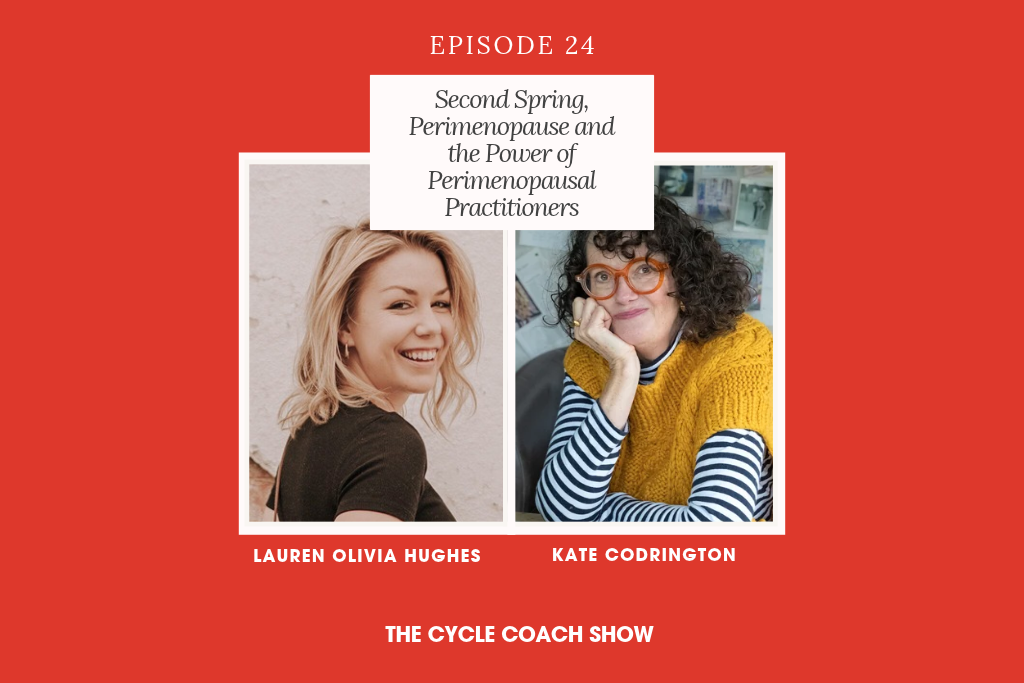
So many practitioners tell me they feel a little nervous about working with women in perimenopause. “I haven’t been through it yet, so who am I to help?” If that sounds like you, this conversation is for you.
Lauren sits down with Kate Codrington, a psychotherapist, menstruality teacher, author of Second Spring and one of our guest teachers at Cycle Coach School. Kate makes this stage of life feel less like an ending and more like a new season, and she’s wonderfully honest (and funny!) about the messy middle.
In this episode:
How discovering menstruality changed Kate’s work as a therapist, and why the inner seasons give the power back to the person in front of you
Kate’s map of the Second Spring, and why so many newly post-menopausal women feel like teenagers again (enormous hats and pottery included)
What Kate sees in her perimenopausal clients: getting clearer on who they are, while not knowing at all who they are
How to support clients in perimenopause when you haven’t been there yourself, starting with naming the fear
Why Kate believes perimenopausal practitioners are some of the best out there
Bringing your autumnal, wintery self-care into your business, and why we do our best work in connection, not competition
Why “perimenopause disrupts patriarchy”
Whether you’re a coach supporting women through this transition, heading into it yourself, or just curious about living cyclically through every stage of life, I hope you love this one as much as I do ♥️
Resources and Links:
Train with us:
Cycle Coach School is open for enrolment all year round, with a self-paced curriculum, live calls with me and our mentor team, and accredited certification included.
Enrol at cyclecoachtraining.com/enrol
November only: $500 off plus nine months of CCS Live with the code NOVEMBER, until 30th November.
Connect with Kate:
Website and free resource library: katecodrington.co.uk
Instagram: @kate_codrington
Second Spring: katecodrington.co.uk/product/signed-copies-of-second-spring-the-self-care-guide-to-menopause/
Cycle Coach School Website:www.cyclecoachtraining.com
Cycle Coach Instagram: @cyclecoachschool
Claire's Instagram: @_clairebaker_
Claire's Website:www.clairebaker.com
Lauren's Instagram:@laurenoliviahughes
Lauren's Website:www.findingjulian.com
Lauren (00:51)
Welcome to the Cycle Coach Show. It's Lauren today, and I am joined by a brilliant guest who you might be familiar with, Kate Codrington. She is the author of Second Spring and the Perimenopause Journal. She's also the host of Life, an Inside Job podcast, and an absolutely brilliant facilitator and coach. So I'm so excited to get to talk to her. Welcome, Kate.
kate (01:14)
thank you, I'm really excited to dive into all these juicy topics we have lined up.
Lauren (01:20)
Yeah, it's gonna be absolutely brilliant. before we do that, though, let's do a a little cycle check-in. uniquely, neither of us are currently cycling. so let's just do a little body check-in of how it feels, maybe comparing it to a phase that we're familiar with. I'll let you start, Kate.
kate (01:34)
Well, first, I want to say that anybody with a cycle who is checking in, that is practice for when you don't have a cycle, really,
Lauren (01:42)
Mm.
kate (01:44)
for when you go off the map. So it's just as relevant for me today. And it's something, I'm checking in with what season I most align to,
70 times a day.
Lauren (01:55)
Okay.
kate (01:56)
And just at the moment, I'm pretty wintery. After lunch is my nap time. Every day I'm like a mother and toddler unit at the moment. Time for your nap, Kate. Okay. So that it's become... No, I can't. I think when we made this appointment...
I said, well, it has to be after my nap.
Lauren (02:17)
You did. Yeah.
kate (02:21)
So, and so I'm quite slow and, yeah, half in a liminal space. So wintry. Yeah. So I'm,
Lauren (02:28)
Mm, mm.
kate (02:29)
I'm, I notice I'm speaking much more slowly than I usually would as a podcast guest, for example.
Lauren (02:35)
Yeah.
Definitely. We'll warm up. No, but
kate (02:36)
I'll speed up pretty quick, but get excited. How about you?
Lauren (02:39)
I I love that reflection of just, take the time to practice now. And I'm currently 11 months postpartum, so I haven't had a cycle in over a year and a half at this point. And it is great practice to just kind
kate (02:51)
Yeah.
Lauren (02:52)
remove the cycle day from the equation because there is still so much
cyclicity in my in my weeks and months, I notice. and so even today I am feeling that wintery energy as well. It was a bit a bit of a busy weekend with my baby and just solo parenting a bit. and so today it's just like, yeah, I'm just feeling like I'm floating, like that bleeding energy of just being like, okay, whatever happens, happens, and it's gonna be great. And we're all here. And just but like
Yeah, I'm I'm resonating with that, like slow pace. Yeah, it'll be wonderful. So definitely feeling that as well. so we'll see where where our minds take us. but I'd love to start at the beginning with you of how did you find this work? How did you become an expert in this realm? Hmm.
kate (03:34)
did I find it? Hmm.
I know. I was in a red tent group and we watched a film whose name I now can't remember, but we'll I'll find it later. We're about periods and menstrual shame and it featured Alexandra Pope. And there was this
sharp-eyed woman talking about, and she was a psychotherapist and so was I, and she was talking about periods and I thought, always had a good relationship with my cycle. I've been blessed with a relatively simple cycle to have a relationship with. And I basically hunted her down and followed her around for about a decade.
Until she got sick of me.
Ha
Lauren (04:20)
Mm. And what what did she teach you?
kate (04:23)
my goodness.
Well, at that point, I'd done a lot. I've I'd learned many modernities and I've done a lot of theory, I'd studied a lot. And a lot of the body related stuff, all the stuff which this was in the
in the 1980s and 1990s. all of the stuff that I was studying, you would now understand a somatic practice is now pretty
Lauren (04:45)
Yeah.
kate (04:46)
mainstream at the time. was very, it was very edgy and peculiar and left field and nobody, everybody thought we were pretty weird. Probably still do, but we were really weird then. And so I had studied a lot of theory in order to try and legitimize and what I was doing to make it
to give it legs to and status really to stand up and say, well, so so says this and this, this, this theory and that research and la la la. And truthfully, none of it really, it was all really in my head. So there was a big, big split between the practice, which was very organic, very body orientated, very flowy, very permissive and transformational. And then the theory just seemed very cognitive and heady.
And it just didn't fit. And what I found with Red Skull's approach as it became was that it explained what I was feeling. This simple, deceptively simple concept of seasons just absolutely married with my inner experience.
Lauren (05:50)
Mm, mm-hmm.
kate (05:51)
in a way that nothing else had. And it totally gave me and gives what I observe through seeing practitioners and my clients and other practitioners work with it, is that it gives back the power to the person in front of you. It is non-hierarchical. It's not the therapist or coach who knows loads of stuff, who drip feeds the other person.
Lauren (06:15)
Mm-hmm.
kate (06:16)
It's a collegial relationship in a way that I think is pretty unique actually, because
Lauren (06:28)
Mm-hmm.
kate (06:29)
every cycle is different. When we start, we learn the archetypal map and you might even have a menstrual cycle, which would be pretty exciting thing to play with.
And then you map the archetypal seasons. then you start to notice, well, I'm not feeling bright and playful in my post bleed springtime, so there must be something wrong with me. And then you start, there's a mini breakdown point when we butt up against the difference between our lived experience and the archetypal map.
Lauren (07:09)
Mm, yeah.
kate (07:11)
And that's the, that is actually a breakthrough point, because that's the point we realize, this is who I am right now. And this, this is my relationship. And then it, it's you suddenly, if you're lucky, you get to drop a few layers into a relational, into a deep, deeper relationship with your site with, with your menstrual cycle in this case, but all cycles, you
Lauren (07:32)
Mm-hmm.
kate (07:33)
I haven't had a menstrual cycle since.
I haven't had a regular one since maybe for maybe a decade, but I certainly haven't had any kind of bleed for eight years or so. I'm postmenopausal. But as I said at the beginning, the understanding of my relationship with the seasons informs everything about what I do, just everything. It's just
Lauren (08:01)
Absolutely.
kate (08:02)
a shorthand and it's just so useful. It's
Lauren (08:04)
Mm.
kate (08:05)
just so useful.
Lauren (08:06)
Yeah, it is. And it's so universal. And I think it's just giving women and menstruators the language that that they need to be able to describe their own experience. And I think because we all know the four seasons, even if you maybe don't live in a country that has the four seasons, you're familiar with them. And so there's that ability to then connect and use metaphor, use language to explain what's happening for you because it is such a unique experience.
kate (08:29)
Yeah.
Lauren (08:31)
And I love what you say about, we we've talked about this in a couple other podcast episodes, but removing the expert, removing the pedestal and having that more like exchange of almost like I visualize women in circle and being able to arrive and of course there's someone guiding the space, but being able to learn from each other. And yeah, I think that's so wonderful approach.
kate (08:52)
m
Yeah, absolutely.
Lauren (08:55)
Mm.
Yeah. Where do I wanna go? My brain just
kate (09:01)
We can just sit here and be in our wintery spaces. That's fine.
Lauren (09:05)
Yeah.
perhaps on the theme of seasons, I would love to
kate (09:09)
Mm.
Lauren (09:10)
maybe touch on your book, Second Spring. I
kate (09:12)
Mm-hmm.
Lauren (09:13)
met a woman a couple weeks ago and she was just discussing how menopause wasn't a word that she resonated with 'cause she was like, There's no pause about my experience and she brought up the the theme of the second spring and I instantly thought of you.
kate (09:27)
you
Lauren (09:28)
people aren't familiar with that if there's perhaps,
younger practitioners who haven't explored this world, what is the second spring?
kate (09:36)
Hmm. Thank you. Well, essentially, it's taking the seasons of the menstrual cycle and mapping it onto our lives. So a teen spring, a summer of our late 20s, 30s, early 40s, an autumnal perimenopause, and a winter of menopause. as I indicated at the beginning, all your menstruating cycle awareness, menstrual cycle awareness even,
is practice for when you don't have a cycle. Because you're going to spend you're going to spend more of your life without a cycle than you do with. In fact,
Lauren (10:11)
Mm-hmm.
kate (10:11)
not having a menstrual cycle is the norm
Lauren (10:14)
Mm-hmm.
kate (10:15)
for female and afoul bodies.
Lauren (10:17)
Mm-hmm.
kate (10:18)
Although you wouldn't think so. Anyway,
Lauren (10:20)
He
kate (10:21)
let's not go down a little rant, that rant, because I'm going to tell you about the season. So you have this map already.
into menopause. then what I observed was, there are different ways of looking at it. There are different maps. So
Lauren (10:35)
Mm-hmm.
kate (10:37)
if you go and work with Jane Hardwick Collins, which I'm sure many listeners will have done or would have encountered her work, she has winter as crone and the end of life.
Lauren (10:48)
Mm-hmm.
kate (10:48)
And there are multiple cycles that we live in. And there is some
truth in that. But I'm I am also a, I was a newly post menopausal person going, but I'm not in winter. I am not this is not autumnal. This is this is just not and and what what what you know.
I'm 60. Hopefully I'll live to, if I average another 22 years or something, I've got, I've got some shit to do here. And I'm in an old, an aging and vulnerable body and strong body and vital body. And I work with deep respect for that. But it's not, I needed more nuance.
Lauren (11:38)
Mm-hmm.
kate (11:39)
So what I've done is to map on a second cycle. So a post-menopausal second spring, hence the title of the book, which is akin to our teen years. So we're banging around going, I'm out of the cave and it's too bright, but I think I'm going to be polygamous and wear enormous hats and take up pottery. Oh no, okay, the pottery has to go that, you we're like, we're all over the place.
And
Lauren (12:04)
Ha ha.
kate (12:05)
it's like, well, why haven't I, know, the thing I most hear from newly post-menopausal people is, but I'm 55. I should have figured out my life by now. this is not the age of the crown of the wise. I'm just not feeling that. I'm just, there is an element of that in that the, menopause.
strips us of our people pleasing of all the estrogenic niceness and people pleasing. So you will see a lot more clearly. So there is, there's a deep wisdom in that. But there's a giddiness about coming out of the cave post menopause that and then again, what I noticed just in the people who live down the street around me is that in the 60s, they've got enough beans in the tank, they've got their bodies are strong. They've got
there may be there a bit more, they have a bit more freedom, some of them. And
Lauren (13:03)
Mm. Mm-hmm.
kate (13:05)
if they have the opportunity, they're doing really interesting things. So that and that is often, that is a privilege, not everybody can do that. Some people are working for jobs at that point. But
Lauren (13:17)
Mm-hmm.
kate (13:18)
there is the desire, that internal desire in the same way as we have that internal desire when around ovulation.
to expand into the world and to give gifts, our gifts in the world through our sixties. um
Lauren (13:33)
Mm-hmm.
kate (13:34)
And that again is followed by a real reckoning in our early seventies when our bodies become a step more vulnerable.
Lauren (13:41)
Mm.
kate (13:42)
And then there's the end of life winter. my, writing at the moment and this is what my next book is about, is about how to navigate that.
And it's really all personal research. How do I do this? my God.
Lauren (13:53)
It
kate (13:56)
Because just as when I started to look around to understand what perimenopause was, I don't see really many guides, solid guides, mapping guides to follow.
there's this ageist belief in decline and irrelevance and uselessness and, being an old hag and, well, there's the ageist gendered ageist trope. And then on the other on the other side, there's this grandiose head standing granny who's running seven marathons and, lifting huge weights and stuff.
Lauren (14:27)
That's not
you.
kate (14:28)
none of this is, none of this is helpful.
Lauren (14:29)
Yeah. Mm. Yeah.
kate (14:34)
So I have a real drive, actually it's a really strong drive at the moment to understand what happens post-menopause. That's my current obsession.
Lauren (14:45)
Hmm. Mm-hmm.
Yeah. And it's work that I know a lot of women need. Even as you're speaking, I was thinking of my own mom. And she started her career at 50. she had raised us and was working different jobs and then started her business at 50. At 60, she took up violin because she'd always wanted to learn the violin. And it's just like these really beautiful moments, or even one of my Yeah, one of my best friends.
kate (15:07)
Yeah, exactly. Thank you. But that's just so normal.
Lauren (15:12)
It is. And like one of my best friends, she's like
kate (15:13)
It happens everywhere. But I think that people don't
see it because we're female and have grey hair. So of course
Lauren (15:20)
Mm-hmm.
kate (15:21)
there's nothing to see here.
Lauren (15:23)
No, but it's and even just one of my best friends, she was like, Yeah, I talk to my mom now and she doesn't she's not asking about me. she's not being a mom. And I was like, Yeah. She's like, even if you just look at the menstru and she is like very in the cyclical world. So I'm like, think of the menstrual cycle. She's in that wild woman, luteal phase energy of just finally being able to reclaim.
Some autonomy and some space after mothering you. yeah, she's starting a business. She's busy. leave her alone. She's she's not your mom anymore. she is, but she's just like, she's doing other things. And it's just like, yeah, it's it's interesting to wrap your head around it sometimes
kate (15:55)
Mm.
Lauren (15:56)
and to see. But I think there is something to be said about giving permission to be like, okay, you you've exited the mother stage. You're not entering Crone yet. there is so much.
life and creativity and almost like selfishness to explore before you then turn into the wise crone who's giving their wisdom, I suppose.
kate (16:17)
Yeah. Yeah. And
also, in case we again fall into the rigidity of an archetypal
Lauren (16:25)
Mm-hmm.
kate (16:25)
map, of course, there will you will be feeling different seasons at different times. So,
Lauren (16:31)
Mm-hmm.
kate (16:32)
for example, classic would be a massive bereavement, or a cancer diagnosis, or
Lauren (16:35)
Mm. Mm-hmm.
kate (16:39)
the loss of a partner or
a friend or, these things will happen at different times of our lives, and they will cause an enormous autumn and winter in our lives. And if we're lucky enough to have this, this cyclical awareness, then we can bring in that understanding. yeah, that this feels a bit like, like the luteal. okay, so I need to slow down and I need to do some more nourishment and
find my joy in a sort of way that worked for me when I was
Lauren (17:07)
Mm-hmm.
kate (17:07)
in that phase.
Lauren (17:09)
Hmm. Yeah,
the work extends beyond just the natural cycle of knowing how to take care of yourself and knowing what you need. Mm-hmm. Brilliant.
kate (17:14)
yeah, absolutely. m
Lauren (17:21)
What advice would you give to practitioners? Because I notice I assist Claire a lot in marking assessments for cycle coach school. And it seems like amongst younger practitioners and facilitators, myself included, sometimes there's almost a fear of working with women in perimenopause, as though like
kate (17:37)
Hahaha
Lauren (17:38)
Just I don't have experience being in that phase.
kate (17:41)
Mm.
Lauren (17:42)
Is there something to be said for for that? obviously there is power in working with someone who's been through it, but is there a possibility for a cycle coach?
kate (17:54)
Well, I think the first thing you do is if you're if you're if you haven't yet been in perimenopause, and you're working with someone who is then the first thing is to name to name that fear with with your client. Say, well, isn't this interesting? there you are in perimenopause. And I've not been in that phase. How is that for you? So you give that to them. And that is part of the relationship.
Lauren (18:17)
Mm. Mm-hmm.
kate (18:18)
And then whatever emerges, they say, well, yeah, I think you're too young and blah, blah, blah, blah. Then that becomes, as if you already have a working contract, is, then that becomes part of what you're looking at. so what is that youth? So it's going to be about them, right? It's going to be about what they think, what they feel they were in their youth before they were perimanipausal. So you can work with that,
And that is a beautiful way and to go dive in really deeply to what the transition, what they're leaving behind and what they feel and then thus where they are now.
Lauren (18:53)
Mm. Mm hmm. Yeah.
kate (18:55)
That's what I think.
Lauren (18:56)
Yeah. Cause I just feel like even in my everyday I keep encountering women who, like you said, there is such a need for for guidance in that phase. And then there's that question of well, do you work with women? And I'm like, I don't like I don't know if that's
kate (19:08)
Yeah.
Lauren (19:08)
supposed to be me. I feel like
kate (19:10)
Yeah,
and then there's the thing about yeah, doing your research, going to chat to you, any other condition that you're working with,
Lauren (19:13)
Mm-hmm. Mm-hmm.
kate (19:17)
you go off and you look at the internet and you go, and then you go and you go and talk to a friend. And then you read some books and then you you find out about that, that situation, whatever it is you're working with, and deeply interrogate your own relationship to it. So if if so,
Yes, probably before you're talking, you're talking to a person, I would be recommending that practitioner works with their relationship with perimenopause.
Lauren (19:46)
Mm-hmm.
kate (19:46)
What are your beliefs about that? What are your fears about that?
Lauren (19:50)
Mm. Mm-hmm.
kate (19:52)
and there will certainly and what how what is your relationship to with the unknown what is your relationship to despair what is your relationship to having no control
Lauren (20:07)
Hmm.
kate (20:08)
because those are the places that your your client is going to be trying to avoid so if you're both if you're both going i don't know are we on video
Lauren (20:16)
Yeah.
kate (20:17)
If you're both going,
really fearful of those places, then there's no hope. You're stuffed. So you have to do the inner work with your relationship with ferry manipause.
Lauren (20:25)
Mm.
kate (20:26)
There's the research, but there's also the inner work that you have to do to be able to sit in those places and that you'll be sitting in some very uncomfortable places.
Lauren (20:35)
Hmm. And having been in that field for so long, are you optimistic or excited about the changes? I Just feel like recently I'm seeing more about menopause. sometimes it's like product specific to menopause that I don't know if they're necessary. but how how are you feeling about how maybe the industry is evolving?
kate (20:56)
Well, it's, it's it's pretty magical, actually. Second Spring came out in 2022. Davina McCall's program on national telly came out in the UK, same year, following year, can't remember. And it went from literally from what is Peri what? Peri what? To everybody knowing about it.
Lauren (21:20)
Mm.
kate (21:20)
the awareness increased a bazillion percent. And there is, And the absence, and the shame has dropped away so significantly. I would, I knew, I knew, I'm not often, I don't often have the such strong knowing, but I definitely knew that change was coming. I knew that perimenopause was gonna be as thing in the same way as period was, and I was gonna be on that bus. It's like, I'm gonna be on the bus. I definitely am.
Lauren (21:45)
Okay.
kate (21:46)
So I knew that was coming for sure. But I was absolutely astonished at the amount of change.
Lauren (21:51)
Mm.
kate (21:52)
And with the level of awareness is also the increasing, increasing levels of fear. There's a different kind of fear and panic that has arisen because being human, humans being human and click baitiness being click baitiness, the headlines are predominantly about the negativity and the fear.
So mostly people are afraid. And we live in a gendered ageist society where fertility is the desired state. And the end of biological fertility is seen as a whopping great catastrophe.
So that opens up a market for lots of people to make lots of money selling you. I was commenting on a friend's, my colleague, Centred Space, Leo's Instagram post, and she was saying, yeah, that the fear creates tightness and dryness in the tissues. And I went, yeah, and then you can sell people collagen to make it all better. It's like, is toxic.
Lauren (22:53)
Yeah.
kate (22:53)
cyclical
mess and there are many many medics medics out there on social media selling selling basically selling medical products which is against the law to meeting that fear and there's the whole
Lauren (23:10)
Mm.
kate (23:11)
weight loss drug hrt enter it's it's
Yeah,
Lauren (23:15)
Mm-hmm. With
kate (23:16)
I find it hard to, I'm very, very picky about what, how I spend, my, how I give my, to where I give my attention because it can be extremely toxic.
Lauren (23:28)
Mm-hmm. When at the end of the day it really
I think I'm starting to notice a bit of perimenopause. And I'm like, Okay. and it's just but it's with a
No, not hesitation, but just yeah, there is a bit of a fear to it to be like, Well what does this mean?
kate (23:40)
Yeah,
Lauren (23:41)
yeah when
kate (23:41)
Well, it's certainly
challenging. I had kids at 38 and 40 and it's certainly challenging with small children. There is a very particular set of challenges that, just at the time when you desire more space and you long for alone time and wide horizons, you have a a gorgeous little creature wrapped around your knee who cannot let you go.
Lauren (24:02)
Mm. Mm-hmm.
kate (24:04)
And, that is tricky.
Lauren (24:08)
Mm-hmm. Or I had a a friend from cycle coach school telling me it's like, if you're having kids around this time, I'm thirty five this year, you'll be going through perimenopause and puberty at the same time. I'm like, good, good, good, good, good, good, good, good. Not a bad thing.
kate (24:21)
people say that, oh, the hormones in the house are terrible, but I was
also pretty mad when my kids were in
Lauren (24:33)
It's like
kate (24:34)
early adolescence. there was a I don't know, I felt a like a we were like the hormonal tribe.
Like everything was
Lauren (24:42)
Well, yeah.
kate (24:43)
so messy. I was like in 50 different pieces and they were all over the place and we were like, yeah, I was, yeah, I don't know. I mean, not that it was very easy particularly, but.
I understood the heightened sensitivity was exactly where I was and I was like, yeah,
Lauren (24:58)
Mm-hmm.
kate (24:59)
it's really hard, isn't it? We've got to learn how to manage this.
Lauren (25:02)
Mm, mm.
Absolutely. So what is the sort of theme you're noticing with your clients who are going through perimenopause? Or what's what are some of the challenges that you're noticing that they're going through?
kate (25:17)
think one of the overarching themes is that they're getting clearer on, it's paradoxical. They're getting clearer on who they are while at the same time not knowing at all who they are. So both together at the same time. And they can see.
your mum learning the violin, they can see avenues opening up well, maybe I, that could be really interesting. And at the same time, they lack the energy to do anything.
Lauren (25:43)
Mm.
kate (25:44)
the...
It's like the, the veils are thin so that you get more, you just get more information. You get more of a spiritual connection. You get your intuition speaks louder. Your body speaks very clearly when it, when you are not on track with what, what it needs. So all that stuff's going on, but at the same time, you have the lack of capacity to do anything about it.
Lauren (26:07)
Ha ha
kate (26:08)
which is just so shit really. It's just awful. So it's an awful irony. But what it's asking us to do is to, because it's an autumnal wintry time, is to stoke the fire, is to fuel ourselves, is to nourish ourselves, to sit tight and nourish.
Lauren (26:25)
Mm.
kate (26:26)
And that's just against everything that we've been taught female bodies should do.
Lauren (26:32)
Mm-hmm.
kate (26:33)
to
not be active, to not go out there and start the new business, to pursue the new training, to get the new man, stride across counties, to have another kid, to move house, don't do any of that stuff. Feed yourself broccoli and have a nap. It's like, what? What? Yeah, for a decade, actually, for a decade.
for a long time and it's mad, it's completely mad. And
Lauren (26:57)
Yeah.
kate (26:58)
obviously we do rush off and do the crazy thing and then
Lauren (27:01)
Mm-hmm.
kate (27:02)
often that hurts and then we come back and nourish ourselves again. So it comes in waves, like contractions,
Lauren (27:08)
Mm-hmm.
kate (27:08)
like a birth. I think
Lauren (27:11)
Sounds
kate (27:11)
that operates on every level, your purpose, like,
Lauren (27:15)
No.
kate (27:16)
I'm gonna...
I saw on Instagram and I've read this research about bones and lifting weights, so I'm going to go to the class. Which is, it's true. It's a great thing to do. Yeah, it really helps. know, lifting weights really helps. But if you haven't slept for two weeks, it's going to be a tough one to get to the class three times a week. It just
Lauren (27:35)
Yep. Yeah.
kate (27:37)
is.
Lauren (27:38)
Mm-hmm. Yeah. And that's where that you unique cycle awareness comes in, where it's like, maybe it's not for you right now. Maybe that Instagram
kate (27:45)
Yeah.
Lauren (27:46)
quote wasn't actually directed at you. let's
kate (27:48)
Yeah.
Lauren (27:48)
take a breath. But yeah, that sounds it sounds like an absolute ride. and so maybe maintaining that thought, that picture of the woman going through perimenopause before we hit record. You mentioned that you work and coach
practitioners in that phase of life.
kate (28:04)
Yes.
Yeah.
Lauren (28:08)
So going through perimetopause and then also being a coach, a facil facilitator, whatever that might be. What does that look like?
kate (28:16)
Well, it looks
like that you what it looks like is that if if you have, if you have an option, I highly recommend people go and work use practitioners who are in primary menopause, because they're very, very good at what they do. Because because they don't have so much energy, they're honed down to what works. It's going
Lauren (28:38)
Yeah.
kate (28:38)
to be really simple, it's going to be really honed. And they're going to be absolutely present.
and also as their, their purpose and their work is getting clearer to them, they're only, they're only going to be able to do the work that they really love. So,
Lauren (28:53)
Mm, mm.
kate (28:56)
that they are just, yeah. I'm, my heart busts open with how brilliant Mary Mennepal's practitioners are. They're ace. they're absolutely brilliant. But where they struggle is that they want to stay in the cave, being with their clients.
Pop-hole fab, great. But being out on social media, really hard. Finding ways to talk about what they do in ways that where they won't burn out, that is really challenging.
Lauren (29:22)
Mm-hmm. Mm-hmm.
kate (29:25)
So a lot of what we do is refine and refine and refine down how it is easeful for them to spread their awareness of their services in the world.
Lauren (29:35)
Mm. Yeah, I guess
kate (29:36)
That's a lot
of what we do. And to take out of their practices and businesses the stuff that overcomplicates.
Lauren (29:44)
Mm-hmm. Mm-hmm. Yeah, because as I mentioned earlier, I've had quite a few women who have been through perimenopause and menopause asking me about the work that I do. And I'm I'm just always like, I just don't think I just don't think we'd be like the best fit. of course I can hold space for women, yes, but there is some magic to having that shared experience. I f I feel at least. Um
kate (30:08)
Mm. Mm.
Lauren (30:10)
And so yeah, I'm just curious, obviously their services are needed. So what is that kind of advice that you give to if they're resistant to social media? So if we have some cycle coaches listening today or people who maybe want to go through the training and they're just like, one more thing to do that I don't want to do.
kate (30:28)
It's to bring the intelligence of your autumnal, wintery self-care into the way that you are in your business.
Lauren (30:39)
Mm.
kate (30:40)
So all the stuff that you do to care for yourself in autumn and winter, and everybody has their own particular thing, different ways of doing that, to bring that into your business consciously and
Lauren (30:55)
Mm.
kate (30:55)
slowly.
So it offer, we will, we will always feel that it's never enough that we're not doing it. We're not doing, that so and so is presenting themselves so much better on Instagram and what's the name has written a book and so and so does a class where that was, well, we'll always feel that we're never quite good enough. Well, hopefully there'll be an end to it, but it's very easy to fall into particularly in autumnal.
States, but to fall back into that care and what is easeful for us, think, is the way forward. And
Lauren (31:31)
Mm-hmm. Mm-hmm. Mm-hmm.
kate (31:35)
you notice I'm not giving specific tips because I don't know what
Lauren (31:39)
No, that's good.
kate (31:40)
somebody's winter might be like. So somebody's winter might actually mean being more active.
Lauren (31:45)
Mm-hmm.
kate (31:46)
It might actually mean moving more, or it might actually mean checking in.
Connection always, mean, connection, I think that's pretty general, don't you think? Like, we all work better with connection.
Lauren (31:54)
Yeah. Mm-hmm.
kate (31:57)
just from the, yeah, just from the session, last week's session, what we were doing was setting up different ways that we can work in connection. So, you you
Lauren (32:05)
Hello.
kate (32:05)
get together at 9.30 every Wednesday with your mate on Zoom and you write some stuff in parallel,
Lauren (32:10)
Mm-hmm.
kate (32:11)
parallel play kind of thing, or you have...
for my creative work, have a loving accountability call, 8.30 every Wednesday. We set intentions, we check in, how did this week go? I didn't do any again. dear, nevermind. What's your intention for next week? to forgive myself for not doing it. Good girl.
Lauren (32:32)
Ha.
kate (32:34)
It's loving accountability,
Lauren (32:35)
Listen. Mm.
kate (32:37)
But it...
These things, these difficult things can only really happen when we're in relationship, I think. Lots of
Lauren (32:45)
Mm.
kate (32:45)
people find that they work much better if they want to generate content or generate ideas in conversation.
Lauren (32:52)
Mm-hmm.
kate (32:53)
It's hard to do that by yourself, sitting by yourself on a computer screen or with crayons. It's easy to get stuck. But if you're chatting with a friend who knows your work,
Lauren (33:04)
Mm. absolutely. Yes.
kate (33:06)
My supervisor
says, you're such an easy client, Kate, because you come here and you tell me what you're going to do. And I say, yeah, that's because you're holding the space.
Lauren (33:13)
Yeah.
kate (33:15)
It's not always that easy.
Lauren (33:16)
I find
Yeah, sometimes it just helps to talk things out and to be like, I actually do know something. Because sometimes when you're sitting
kate (33:23)
Yes.
Lauren (33:23)
by yourself at home alone staring at your computer, you're like, What am I what am I doing? Who wants who wants this?
kate (33:29)
Exactly, exactly that. We don't know. I
would say that for if you know that you're that you get your best ideas in conversation to make
Lauren (33:38)
Mm.
kate (33:38)
that part of your business and that there's some wintry care there. It's a bit like coming into circle and
Lauren (33:45)
Mm.
kate (33:45)
saying I lose it on day 21 and I think I'm going to kill my partner. It's the same effect. And you come into you come in with your friend and you say, I don't know anything.
I don't know what I'm doing. I don't know what is my work. And your friend says, okay, do you not remember? Let me remind you of this amazing thing you've done and that client and this thing and that, you But to make those connected relational, I guess, make it into a structure, I think, in your life so that you know that you meet with Alexander every
months and Jane every Wednesday at 8.30 and whatever it is so
Lauren (34:26)
Mm.
kate (34:27)
that you're held in a web of connection.
Lauren (34:31)
Mm. Mm. Yeah.
kate (34:33)
There you go, that's a tip.
Lauren (34:34)
Hot tip. No, but it does it does really resonate because I think I came into business. I'm from Canada originally. So very like that North American hustle culture was ingrained in my body of the self made millionaire who who made it there on their own. And then it's just like trying to dismantle all that to be like, actually, we do much better.
when we collaborate, when we're together in community, when we can support and celebrate each other, really.
kate (35:01)
Yeah,
so it's so interesting that you say that because the hustle culture thing but there is a the con the aspect of competition in our working lives is really strong. And that own
Lauren (35:09)
Mm-hmm.
kate (35:11)
competition only that keeps us small and it keeps us mediocre, I think
Lauren (35:14)
Mm-hmm. Mm-hmm.
kate (35:16)
because instead of going into our own weird little peculiar niches of special interest.
Lauren (35:22)
Mm-hmm.
kate (35:23)
go well, that's too weird. So I have to talk for me. I'm like,
You can't talk about that. You can't talk about post-menopause because that's too weird. So why
Lauren (35:30)
Mm-hmm.
kate (35:31)
don't you talk about, my inner critics say, why don't you talk about, I don't know, what broccoli? Talk about broccoli, Kate. I'm like, I can't write another sentence about broccoli. I just can't. I've been doing it for 15 years. No. But the competition makes us, pushes us
Lauren (35:45)
We do.
kate (35:46)
more into the mainstream and it keeps us divided.
as if I see you, you being your brilliant self, and I'm, I wish I could be more like that. But
Lauren (35:56)
yeah.
kate (35:56)
as soon as as soon as we get together and talk, and we we talk about our actual experience of running our businesses, it's like, so I'm not so alone. And I could use this aspect and you could use some aspect or something that I'm doing and it becomes much more norm, the feeling of being lost or failing or not knowing or being afraid.
becomes normalized and it's something that has to happen. it comes, we come into community, but the dominant culture is that you have to, you have to survive alone. You can't ask for help.
Lauren (36:26)
Mm-hmm.
kate (36:27)
You're not allowed to, and in all aspects, parenting is just the same, right? you've got a soldier on regardless. And if you go to a class about how to parent your child, then clearly you're struggling and that's catastrophe. know.
brackets, we're all struggling. No one knows how to do it. There isn't any right way. We're all fighting in the dark, desperately trying to get it right.
Lauren (36:46)
God, yeah, has been interesting parenting in in Britain, in Scotland, and just encountering the very British or European culture of keeping your cards close to your chest. And I'm like, I'm having a really hard time, you guys. And they're like, no, Lauren, no, and I'm like, Really? No one else, no, no one else is struggling right now. And then it took took months, but eventually they're like, I'm having arguments with my partner. I'm like, Of course you are. of course you are
kate (37:11)
You are such a
gift. You are such a gift to these people. I can only imagine how happy they are that you're
Lauren (37:14)
You're so
kate (37:17)
normalizing the awfulness of parenting.
Lauren (37:20)
gosh. It's yeah, wonderful in many ways. But my goodness. So it's no, but it is so true that that competition mindset has Yeah, it just removes yours off your life, I think. Just com comparing yourself on social media and being like, God, what are they doing? And it's like what who cares? I just think it's yeah. There's space for us to be our weird selves and we don't need to sound all the
kate (37:46)
Yeah.
Lauren (37:46)
same and
if we could just learn those lessons from parametopause earlier in life, wouldn't that be nice? But
kate (37:53)
Well, yeah, and I think that by honing in on your cycle as a teacher, you are. That's what you are doing because in
Lauren (37:59)
Hmm. Hmm.
kate (38:01)
every luteal phase, every menstrual autumn,
Lauren (38:05)
Hmm.
kate (38:06)
you get a taste of that perimenopause, other space, that difference. So
Lauren (38:09)
Mm, mm, yeah.
kate (38:13)
you're honing your skills at that point.
Lauren (38:15)
Yeah, I do love that phase.
I was on your Instagram and I love the quote Perimenopause disrupts patriarchy.
Could you talk more about that?
kate (38:25)
Hmm.
Yeah, well, it's just, we stop being nice.
Lauren (38:31)
Mm. Mm-hmm.
kate (38:33)
Simply that, as estrogen change, as estrogen fluctuates, estrogen is very good for keeping, keeping us in service to the world and to other people. And we need that, as, as,
humans and as parents, it's such a gift. But when that starts to change, we start to say no and our boundaries start to become clearer to us. And we start to express them, usually very messily and loudly and furiously and suddenly out of the blue. And it's very inconvenient for the world because we're supposed to just keep going on.
And we're not supposed to. I wish I could remember the name of the book. There's a there's a book that is a bestseller at the moment. the woman I have also any the woman just parks her car. She's in a traffic jam and she just leaves the car in the middle of the jam. And it everybody wants to do that. I was in a traffic jam today fantasizing about that thing. But in perimenopause.
Lauren (39:35)
Mm.
kate (39:36)
It's a great metaphor for what happens. We parked the car and we're not doing it anymore.
Lauren (39:40)
Hmm, mm.
kate (39:43)
And it's very disruptive. So and if you think about the sort of emotional aspect, you're not supposed to as a female or assigned female at birth person, you're not supposed to be furious and angry and shouting.
Lauren (39:59)
Mm-hmm.
kate (40:00)
Go on, mate, give us a smile. gets shouted across from, well, not so much now, but used to get shouted across building sites, that we have to be smiling and at all times with a rictus grin in case something bad happens to us. And that goes away. So the angry person is labeled demanding all that, and in the past, women were commonly locked up and medicated because of it.
Lauren (40:23)
Love Rise.
kate (40:28)
The other, another aspect is that the, I suppose I could say that our whole system becomes more sensitized.
Lauren (40:34)
Mm.
kate (40:35)
So while we, your, your mum, your mum group before you soften them up.
Lauren (40:40)
Hmm.
kate (40:41)
And there was a fashion to have mugs and tea towels with keep calm and carry on.
Lauren (40:47)
Yes.
kate (40:48)
Yeah, and there was, I think it was one of the Tory politicians actually told some woman and some MP in parliament to calm down, There's a thing about that you just carry on, whatever the emotional turmoil is, you carry on. And with the shifts in hormones through perimenopause,
our whole system becomes more sensitized. So it's the emotional aspect, yes, but also we become often suddenly more sensitive to different food types or to environmental chemicals or to emotionally or to watching the news or to we're just more effective. Well, I learned the other day that amphibians are much they're like the canaries in the coal mine for
in this country for climate change because they absorb things through their skin and I was thinking
Lauren (41:37)
Mm.
kate (41:37)
yeah it's a bit like perimenopause that we know when stuff is wrong sooner
Lauren (41:42)
Mm.
kate (41:42)
than other people who are in a different stage of life and it's very inconvenient because we're going, oi, no, this is not working, this is not okay.
and so much, there are, the caring work that women do, the unpaid, unacknowledged, invisible
Lauren (42:01)
Um
kate (42:02)
caring work that women do is, it's like, off the scale. And it,
Lauren (42:08)
Mm-hmm.
kate (42:09)
yes, parenting, but also looking after relations about older people, disabled people in your family, neighbors, and then, that, that caring work.
to continue and it's unpaid.
Let alone the emotional labor, you know, the
Lauren (42:24)
Mm-hmm.
kate (42:24)
holding of the and the mental labor of, well, so and so likes this spoon and that bowl and so and so is going off to a football match on Thursday. So they'll have to have that shirt ready then because they're going to be there. And then they have to have that shirt ready on Monday afternoon because they're going, it's it's a
Lauren (42:42)
Mm-hmm. Mm-hmm.
kate (42:45)
personal assistant type.
fuck nexus of arrangement that most women with children have to do. And then perimenopause means that we, our capacity to hold all that information is loosened.
Lauren (43:00)
Mm-hmm.
kate (43:01)
And sometimes it disappears.
Lauren (43:03)
Mm. Yeah.
kate (43:04)
and all the plates fall down.
Lauren (43:06)
Yeah. And then what happens? Then what happens? Because we do because
kate (43:07)
And some that, you know, what's going to happen? Then what happens?
Lauren (43:11)
women, yeah, and AVAB people are like, they are in my mind the natural leaders. Like you said, they do carry so much the mental load and just I saw this quote on Instagram the other day of, why did women fight to work? It's like we didn't, we fight we fought to get paid. We women always worked, women always had jobs, it's just that they weren't recognized and it's still so much so much of that and
Yeah, even today seeing so many of my mother friends going back to work and getting jerked around by their companies that are hiring them and just it's it's exhausting. So I can imagine when you're finally in that perimenopause of
kate (43:46)
Yeah. Yeah.
Lauren (43:48)
that lutile energy of being like, I actually don't care.
kate (43:51)
Yeah. Okay,
so I'm gonna, I'm gonna back up a bit and I'm gonna say, give you the, the, it's like a correct, say that it's this is a corrective force. So
Lauren (44:02)
Mm.
kate (44:03)
by allowing the plates to fall, by allowing the feelings to be unruly to be expressed by allowing
Lauren (44:10)
Mm-hmm.
kate (44:11)
the decades old trauma to come to the surface and be processed.
We are first of all demonstrating that vulnerability is not the end of the world, that
Lauren (44:23)
Mm.
kate (44:24)
giving permission to also to be vulnerable.
Lauren (44:26)
Mm-hmm.
kate (44:27)
We can ask for help from our people around us, from practitioners, from family members, from friends. I need help here because I'm really struggling just as you were talking about.
Lauren (44:39)
Mm.
kate (44:40)
And we can also ask other people to step up. So it's egalitarian. It's like, okay, this, I'm not able to do. I don't, I don't have any football in my life at all, but let's use that example as it came up that I'm not able to manage the football laundry anymore.
Lauren (44:58)
Mm-hmm.
kate (44:59)
I need you to take this over the
Lauren (45:01)
Mm.
kate (45:02)
whole thing. It's like, I don't, I don't, reminds me of, can't, I, Oh God, I wish I could remember where this was, but.
talking about emotional load and I think it was a partner saying, okay, the client or colleague or whoever it was saying, okay, to that partner, need you to do the food shopping. And so they say, okay, give me a list. But no, you need to plan the meals and they all have to be healthy. And then you have to figure it out. I need all of it taken care of. often in delegating.
work and this this is true of business as well we can then we can then give ourselves double the work but we need to give the whole job to the the people around us and
Lauren (45:45)
Mm-hmm, mm-hmm, mm-hmm, mm-hmm.
kate (45:51)
that includes that includes kids they they it's part of our job as parents is to teach them how to take care of themselves so they don't so they understand how to use a washing machine and make some basic food and
Lauren (46:02)
Mm-hmm. Hmm. Yeah.
kate (46:04)
and
to teach them how to ask for help themselves in
Lauren (46:07)
Mm-hmm.
kate (46:07)
a way that doesn't humiliate them so that they know that it's okay.
Lauren (46:11)
Mm-hmm. Yeah, because there's a difference between asking for help and then needing a list all the time. let's learn to look around before I burn
kate (46:18)
Yeah.
Lauren (46:19)
this house to the ground. Hmm. Yeah. And I do think it it there is, yeah, like you said, perimetopause disrupts patriarchy. There's something there of as we accept this phase and as it becomes more celebrated, normalized.
anticipated, understood, whatever language we need to use around that, it's yeah, I think it'll lead us into a new world of sorts.
kate (46:46)
Yeah, it does. And it's a gateway into something like I can't tell you how much fun it is to be post-menopausal. It is the most fun. I was at a social thing last week and I was chatting to a young man. He was 35 or something. And also a writer. And we were talking about competition and envy and stuff. And he says, doesn't that bother you? And I was like, nah.
Nah, it's
Lauren (47:13)
We'll stop.
kate (47:15)
not a pause. You should try it, It's great. It cleanses you of all that bullshit. Fantastic. I was like, no, you can't. Too bad.
Lauren (47:23)
Mm, it's
unique for us.
kate (47:25)
Because
my purpose, it sounds so grandiose, but I know so clearly what I can and can't do.
Lauren (47:34)
Mm-hmm.
kate (47:35)
My energy isn't that, it's pretty low. So there's
Lauren (47:37)
Well.
kate (47:38)
no point in wasting it doing stuff, trying hard to do stuff that isn't my jam.
Lauren (47:44)
Mm-hmm. Or worrying about what other people are doing. No.
kate (47:48)
No, no, I don't I don't have I don't have enough energy for that. It's very
clarifying. It's wonderful. And you can play and very cool. Accepting
Lauren (47:56)
Mm.
kate (47:58)
endings or let's talk about death thing as we're here, you know, we're nearly at the end of our chat, I guess. So we can't
Lauren (48:00)
Yeah. Please do. Yeah.
kate (48:03)
have we can't we can't have a podcast podcast without talking about death. And,
Lauren (48:08)
Ha ha
kate (48:09)
Just as you move into the luteal phase and the illusion of being Wonder Woman has to be released every month. Same thing with perimenopause. This illusion of being the all singing, all dancing female, socially constructed female has to be released.
something else is going to happen. You might go down the Botox and fierce body constriction route, that's a choice. Or you might go down a more, kinder route, that's also a choice. But it's a shift, it changes. And the difficulty comes when people do not face that there is an end. And we don't want, we don't, don't, we're grief averse, we don't like it, we don't, we want everything, we want to be teenagers forever.
people talk about being a queen ager and I get it but it there's also an ending that has to be embraced queen ager like a a
Lauren (49:03)
We major?
kate (49:05)
another word for perimenopause like a teenager but a queen ager you're at the age of the queen I get it and I I can see why people use
Lauren (49:11)
Mm-hmm.
kate (49:15)
that but there's also there's also a death in perimenopause and the joy of that is that accepting that liberates
you to be alive in the moment. And I think that's
Lauren (49:25)
Mm-hmm.
kate (49:26)
what happens as we age, what can happen as we age, as our mortality comes closer, as my, I speak personally, as my mortality comes closer, every moment is so precious. And
Lauren (49:37)
Mm, mm.
kate (49:38)
I feel so much more alive than when I thought, well,
so many opportunities that I'm not taking and I want that thing that far away thing over there and that far away thing over there and be this, be this person and that person. It's like the curse of potential, you the
Lauren (49:54)
Mm.
kate (49:55)
idea of being, you can be whoever you want to be always keeps us wanting to be somewhere else.
Lauren (50:01)
Yeah.
kate (50:02)
The gift of facing our mortality is that you're here now with joy
Lauren (50:06)
Mm.
kate (50:07)
in whatever
with whatever life is bringing you.
Lauren (50:11)
Mm, that's beautiful.
kate (50:13)
So I just
dropped that one in at the end.
Lauren (50:16)
Full seasoning at the end.
kate (50:18)
Little seasoning, little sprinkle.
Lauren (50:21)
I do I will just say in this postpartum season I'm like I feel like it's like a tiny the tiniest, tiniest sneak peek into perimenopause, just in the in the way that like
kate (50:31)
Mmm.
Lauren (50:32)
I don't have the capacity for anything and I don't like so it's just there is a bit of that just this is what I have to offer, nothing else. And
kate (50:40)
Yeah, absolutely. think it's
very, very similar, very permeable. Where is your
Lauren (50:44)
And that relation to death.
kate (50:45)
edge?
Lauren (50:46)
Yeah. The relation to death of just staring at my baby being like, my god. The time we have is slipping. Just like, okay.
kate (50:52)
Yeah, exactly that. And
I once interviewed Shani Hugo-Wolitzer about caring, you how to look after yourself when you have kids.
Lauren (51:01)
Hm.
kate (51:02)
I think cycle awareness was relatively young at that point, and it hadn't really been talked about enough,
Lauren (51:08)
Hmm.
kate (51:09)
in my opinion. And I asked her, so what advice would you give to pregnant women? And she said, you're going to die.
And what she meant was, what she meant was, everything you thought you were is going to die.
Lauren (51:23)
Mm-hmm.
kate (51:23)
Who you thought you could be is going to die. Your grounding is going to shift and you are
Lauren (51:27)
Mm. Mm-hmm.
kate (51:29)
going to feel like you are going to die. And everything has to die in order to embrace
Lauren (51:35)
Mm-hmm.
kate (51:36)
this new life and to be with this new life. know,
Lauren (51:39)
Absolutely.
kate (51:40)
that's my best quote ever. was hilarious. Of course, she'd never said it really.
Lauren (51:45)
Cut it.
kate (51:44)
real life. And I think
she was even a hip birth hypnosis teacher at that point or had been so she knew it she knew the stuff really
Lauren (51:53)
Yeah.
kate (51:53)
well she had a couple of kids herself.
Lauren (51:55)
No, it's good advice. I yeah, I always like well, my mom always said, having a kid sh felt like having her ankles grabbed and shook upside down. and I think
kate (52:02)
Hmm.
Lauren (52:03)
she would say menopause was probably very similar, just from what I witnessed. So
kate (52:08)
Yeah.
Lauren (52:09)
Thank you so much for today. I just feel like I could talk to you for hours. it's only been one. where could people find you and connect with your work?
kate (52:16)
I have a website, because I'm very modern that way. And
Lauren (52:17)
Hmm.
kate (52:21)
it's Kate Codrington.co.uk and mostly my socials are on Instagram, where I'm
Lauren (52:27)
Mm.
kate (52:27)
also Kate underscore Codrington. And I have a great, if you want to get a feel for my work, I have a very bulging free resource library that's stuffed full of yoga nidra and maps and visuals of the seasons so that you can
I don't know, have a rummage in there and see what you think.
Lauren (52:44)
Yeah, that's phenomenal. We'll link it in the show notes. Um
kate (52:47)
Thank you.
Lauren (52:48)
yeah, thank you so much for spending some time with me today. And yeah, we'll chat soon. All right.
kate (52:54)
Thank you.

Thank you so much for listening!
We love that you've taken time out to listen and explore more about menstrual cycle coaching . If you loved this episode please share it with someone you know will benefit, and/or on social media.
You can also leave a review on Apple Podcasts, this will ensure more and more people will have access to this content and one-by-one we can change the way the world views cycle coaching!
Subscribe to The Cycle Coach School Show so you never miss an episode: