

Cyclical Planning for Practitioners

If you’re a practitioner who wants to plan your work in a way that honours your body, your creativity and your cyclical nature, this is for you.
This approach to planning is rooted in cyclical thinking: long-term vision, seasonal energy, realistic capacity and rhythms that actually match how we humans, especially those of us who menstruate, work.
Below, I’ll walk you through how to plan a year in a way that supports sustainability, creativity, and depth.
You’ll also find two free tools at the end:
A “Relaxed Year of Work” planning spreadsheet
A simple menstrual/bleed tracker calendar for Google or iCal
Okay, ready? Let’s get into it!
1. Start with the next five-ish years
Before we get into your new year, let’s zoom out.
So instead of starting with, “What am I doing in January?”, let’s begin with: “What do I want to happen in the next five-ish years?”
This immediately calms the urgency that creeps into yearly planning. Most of us wildly overestimate what can happen in one year and underestimate what’s possible over five.
You might reflect on:
The kind of practitioner you want to be
How much you want work to centre (or not centre) your life
Whether you want to write, teach, train, travel, root, grow or rest
The kind of community, rhythm and sustainability you want long-term
When you look back over the last five years of your own life or business, you’ll probably see a handful of meaningful projects, done deeply. That’s legacy work.
You don’t have to do everything you could ever dream of in the next 12 months!
2. The vibe of the year ahead
Once you’ve zoomed out, you can zoom back in and ask:
“What’s the vibe of the year I’m about to enter?”
This isn’t just about goals, but also about:
Your life season
Your nervous system capacity
What your body is actually asking for
Your word or phrase for the year might be:
Healing
Rooted
Quiet
Visible
Spacious
Fertile
Brave
Slow
You might also be moving through big life transitions of your own, like relocating or starting/ending a relationship, becoming a mother, or something else entirely.
This all needs to be taken into account too.
Remember, your life season gets to shape your work season. Cyclical planning means we can’t keep planning as if our bodies and relationships are background tabs!
3. Write your list. Then cut it in half.
Once you’ve felt into the longer arc and the vibe of the year, it’s time to write your list.
Write everything you want to:
Build
Teach
Launch
Study
Create
Share
And let yourself really go there! Feel into the possibilities. Give yourself permission to vision and name it all. Dream like an eagle, plan like a mouse.
Then, gently but firmly, I invite you to cut it in half.
Two truths most practitioners eventually meet:
You can only meaningfully focus on a few things at once
The things that matter most take longer than you think
I know! It can be tough to hear. But this isn’t failure, it’s discernment.
Cutting the list in half is how you choose what’s genuinely worthy of your energy, focus, attention and life minutes.
The rest doesn’t have to disappear. It simply goes back into your five-year field.
And who knows? Maybe you’ll get to it, but only after prioritising what matters most.
4. What are your creative seasons?
There’s enormous relief in letting your creative seasons lead your annual planning, rather than expecting the same output all year.
So before you build timelines, ask yourself:
When do I naturally feel the most expressive, visible, bold, creative and outward-facing?
You might reflect on:
Which months you feel most alive, social and creative
When you tend to want to teach, coach, share or launch
For some people:
Spring and early summer is a surge of ideas and visibility
Early autumn “back to school” is peak teaching energy
December and January are naturally quieter
And then: when do I naturally feel more inward, quiet or want to take time for rest away from work?
This is where Simmer Seasons and Fallow Phases come in.
Simmer Seasons: Work is happening, but on low heat. This might look like fewer calls, a slower pace, tinkering away on backend work and more white space in your calendar. Weeks or months when things are a little quieter.
Fallow Phases: Actual non-production. This means time in your business where there are no launches, far fewer commitments, time away from your projects and clients, and a proper rest.
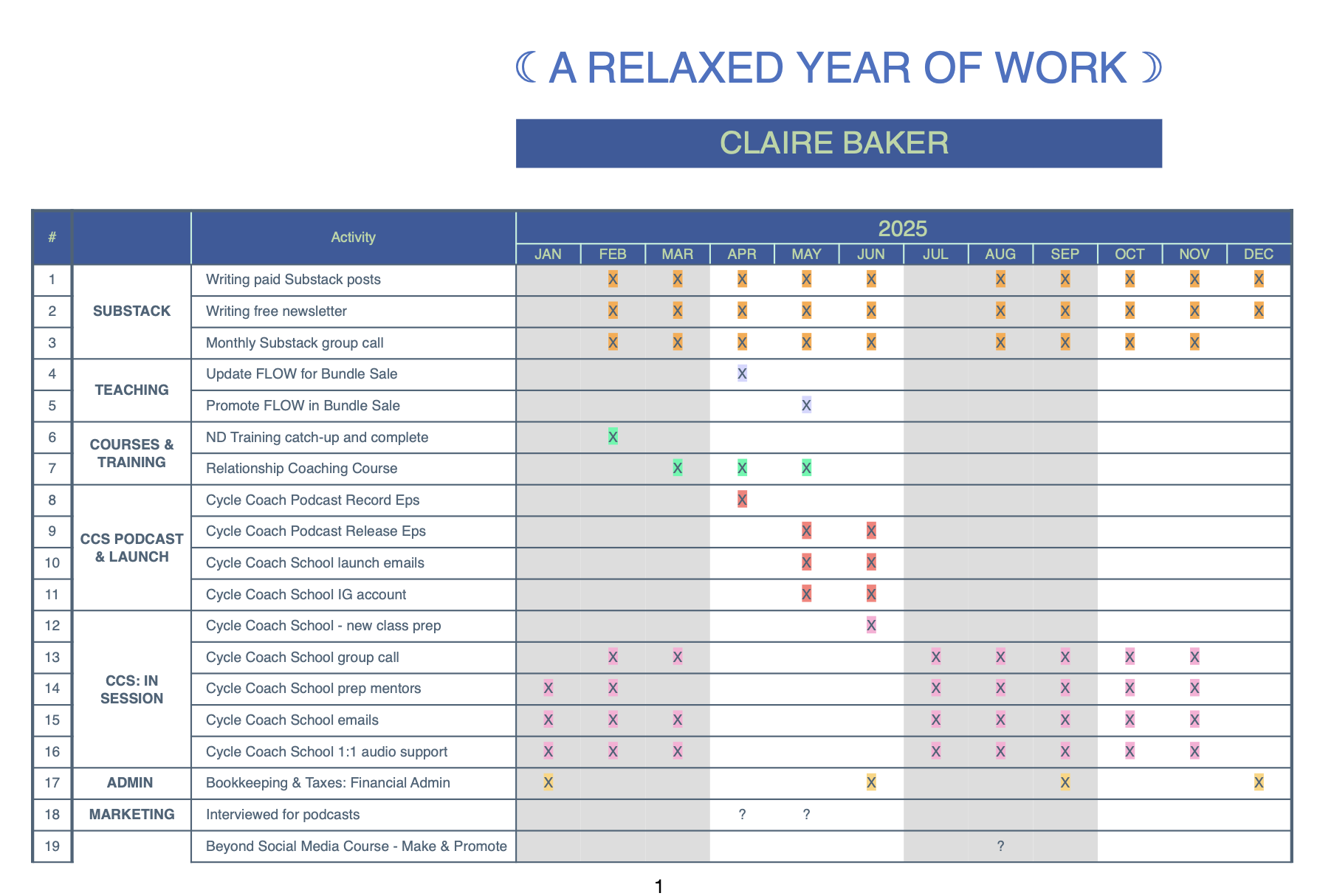
To map out your more creative chapters, simmer seasons and fallow phases, you can use a very simple spreadsheet I call the “Relaxed Year of Work.”
Here’s how it works:
Down the left: all projects and commitments (client work, teaching, writing, podcasting, admin, marketing, launches, etc.)
Across the top: the months of the year
Then simply mark an X for which months each project is “on”
Instant clarity appears:
“May and June are stacked, way too many burners.”
“July looks like a natural simmer month. Let’s keep it like that.”
“If I add something in September, what needs to move or drop?”
👉 [Relaxed Year of Work – Annual Planning Spreadsheet Template]
5. Weekly, monthly & menstrual rhythms
Once your year has a shape, you can gently zoom in again to your:
Weekly rhythm
Monthly rhythm
And, if you have one, your menstrual rhythm
You might experiment with:
A/B weeks. e.g. Week A is for client calls/meetings and Week B is for content, admin and backend work. I’ve done this forever and it works so well for me!
Designated no-client or meeting days each week. For me, this is Mondays and often Fridays.
Not scheduling launches or peak output during the week you usually bleed, or the days leading up to it, if that’s available to you.
If you do have a menstrual cycle, a very gentle seasonal lens might look like:
Menstruation = winter
Rest, reflection, visioning, fewer outward demandsPre-ovulation = spring
Planning, researching, initiating, beginningOvulation = summer
Sharing, visibility, teaching, collaboration (or time away from your desk to be with family and friends!)Pre-menstruum = autumn
Editing, refining, deep creative work, slowing
You do not need to perfectly restructure your life every week.
Even small adjustments, especially in our own awareness and how we hold ourselves depending on our cycle day, can really change how supported your work feels.
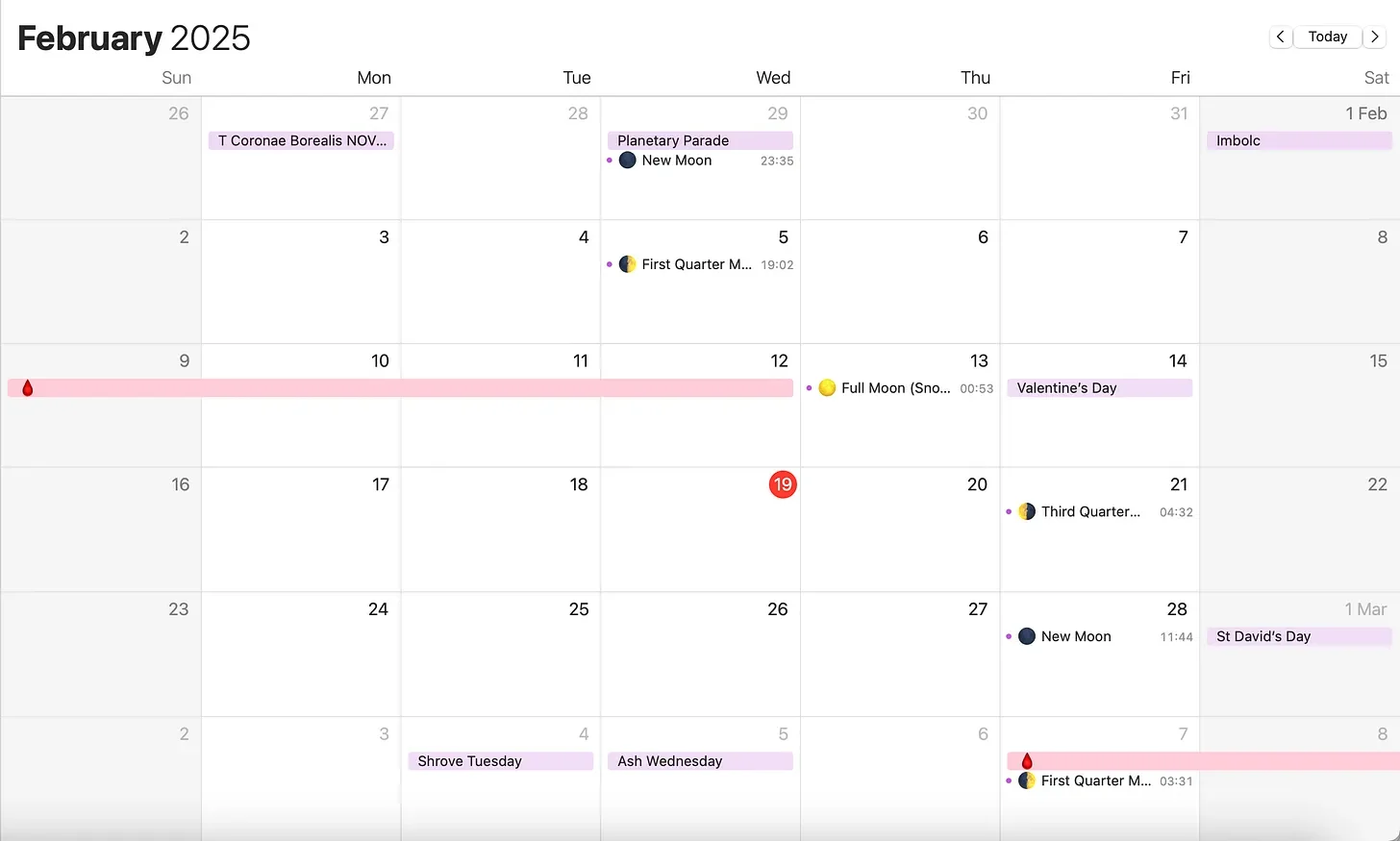
If you’d like to map your bleeds alongside the year, try this free period tracker my partner made for this community. And let me know how you find it!
Note: some practical thoughts on money
Now, I’ve noticed that lot of people worry that slowing down and working cyclically means earning less.
Sometimes there are seasons where you absolutely need to prioritise income. But in practice, most practitioners I know don’t earn more in the long-term by never ever resting.
Cyclical working becomes much more realistic when your finances are allowed to be cyclical too.
In fact, sustainable income is more often supported by:
Focusing on fewer offerings
Pricing with respect to your specific income needs
Letting some projects go
Building a financial buffer to prepare for quieter seasons
Implementing a “pots” strategy where revenue is distributed across expenses, owner pay and tax, for every dollar that comes in. This helps to avoid the feast or famine phenomenon!
I recommend the book Profit First by Mike Michalowicz to learn more about this strategy.
Here are a few reflective prompts you might like to journal on:
What do I want to unfold in my business in the next five-ish years?
What’s the vibe of the year ahead?
What do I want to work on, build or create?
If I cut that list in half, what stays?
What are my top 3 priorities for the new year?
When do I naturally feel most creative and visible?
Where do I want simmer seasons and fallow phases?
Where in my month can I build in both time off and time to create?
How about in my week?
I hope this offers you a gentler, more spacious way to plan your year.
And do check out our recent podcast episode on the same theme, where Lauren and I go into our plans for the new year.
We also include another helpful framework for you to do your annual reflections.
Warmly,
Claire x
If this concept of cyclical planning lights up something in you…
come join us inside the Cycle Coach Self-Study.
Your future clients will thank you!